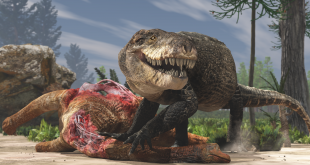
Named Razanandrongobe sakalavae, the ancient predatory crocodile had a deep skull and powerful jaws with enormous serrated teeth that are similar in size and shape to those of Tyrannosaurus rex, according to new research led by Dr. Cristiano Dal Sasso of the Natural History Museum of Milan. Razanandrongobe sakalavae scavenging …
Read More »Scientists Say Mass Extinction of Marine Megafauna Occurred 2-3 Million Years Ago
A previously unknown mass extinction may have killed up to a third of large marine animals 2-3 million years ago, according to an international team of paleontologists. Carcharocles megalodon pursuing two prehistoric whales. Image credit: Karen Carr / CC BY 3.0. The team, led by Dr. Catalina Pimiento of the …
Read More »Giant Flying Turkeys Lived in Australia 1-3 Million Years Ago
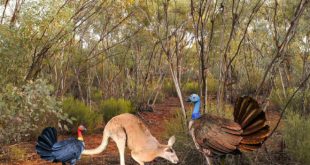
Progura gallinacea, a species of extinct giant brush turkey that lived in Australia during the Late Pliocene and Early Pleistocene (1-3 million years ago), is among five megapode birds described (or redescribed) by Flinders University paleontologists. A reconstruction of Progura gallinacea (right), alongside a kangaroo and modern bush turkey (Alectura …
Read More »Paleontologists Find Oldest Fossil Mushroom: Gondwanagaricites magnificus
Gondwanagaricites magnificus represents the oldest fossil mushroom to date and the first fossil mushroom from the ancient supercontinent Gondwana. The gilled mushroom Gondwanagaricites magnificus lived during the Early Cretaceous, a time of dinosaurs when Gondwana was breaking apart. Image credit: Heads et al, doi: 10.1371/journal.pone.0178327. Gondwanagaricites magnificus was about 2 …
Read More »Elephant Family Tree Needs a Rewrite
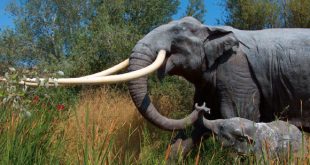
According to new research published in the journal eLife, the straight-tusked elephant (Palaeoloxodon antiquus), a species of giant elephant that lived 1.5 million to 100,000 years ago, is more closely related to the extant African forest elephant (Loxodonta cyclotis) than the forest elephant is to its nearest living relative, the …
Read More »Pioneering Technology Sheds New Light on Megalosaurus, World’s First Scientifically-Described Dinosaur
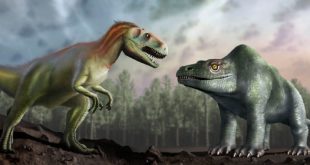
A state-of-the-art CT scanning technology has shed fresh light on Megalosaurus bucklandii, the first dinosaur ever named and described scientifically — thanks to new research from the Universities of Warwick and Oxford, UK. Artist’s impression of how Victorian paleontologists thought Megalosaurus bucklandii looked (right), compared with how we now understand …
Read More »Japanese Paleontologists Unearth Nearly Complete Skeleton of Duck-Billed Dinosaur
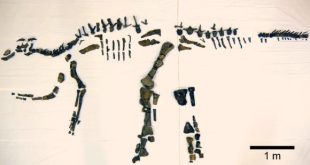
In a stunning fossil discovery in Japan, paleontologists unearthed a nearly complete skeleton of a duck-billed dinosaur that lived approximately 72 million years ago. A nearly-complete skeleton of the duck-billed dinosaur Mukawaryu. Image credit: Hobetsu Musem / Hokkaido University Museum. Duck-billed dinosaurs, or hadrosaurids, are members of the family Hadrosauridae. …
Read More »Earth’s Earliest Primates Lived in Treetops, Paleontologists Say
Earth’s earliest primates were tree dwellers, according to a team of paleontologists led by Dr. Stephen Chester, an assistant professor at Brooklyn College, City University of New York. Skeleton composite of Torrejonia wilsoni: most elements of the composite skeleton are in ventral view, but some elements are oriented differently to …
Read More »Paleontologists Identify New Pliosaur Species: Luskhan itilensis
A new species of marine reptile from the Cretaceous period has been identified from fossils found on the eroded banks of the Volga River. Artist’s reconstruction of Luskhan itilensis. Image credit: Andrey Atuchin. Pliosaurs, also known as pliosauroids, were a type of short-necked plesiosaur: marine reptiles built for speed compared …
Read More »Ordovician Mass Extinction May Have Been Triggered by Volcanic Eruptions
Geologists from Tohoku University, Japan, Amherst College and Washington University in Saint Louis, the United States, say they may have found the cause of the end-Ordovician mass extinction, the first of the world’s five known mass extinctions. Ordovician sea life. Image credit: Vince Smith / American Museum of Natural History …
Read More »