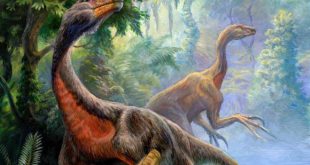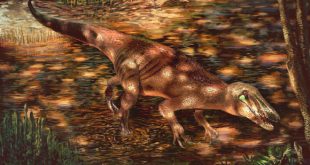
Ground-dwelling birds survived while their close, tree-dwelling relatives went extinct during the end-Cretaceous mass extinction event, caused by the impact of an asteroid off the Mexican coast some 66 million years ago, according to new research. A hypothetical surviving bird lineage — small-bodied and specialized for a ground-dwelling lifestyle — …
Read More »Paleontologists Find Fossilized Dandruff of Feathered Dinosaurs
An international research team led by scientists at University College Cork, Linyi University, and China’s Institute of Vertebrate Paleontology and Paleoanthropology has found and analyzed dandruff fragments preserved amongst the plumage of Cretaceous feathered non-avian dinosaurs, revealing the first evidence of how dinosaurs shed their skin. A pair of Beipiaosaurus …
Read More »Paleontologists Discover Fossil of Early Mammal Relative in Utah
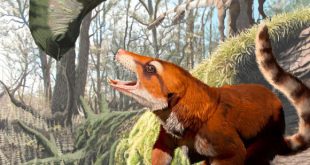
A team of paleontologists has discovered and described the nearly complete fossilized skull of a previously unknown mammal relative that lived about 130 million years ago (Early Cretaceous epoch). The study appears in the journal Nature. Cifelliodon wahkarmoosuch. Image credit: Jorge A. Gonzalez / Keck School of Medicine of the …
Read More »Sweet Potatoes May Have Originated in Asia
57-milion-year-old leaf fossils from eastern India suggest that the worldwide-distributed morning glory family (Convolvulaceae), which includes sweet potatoes and many other plants, originated in the late Paleocene epoch in the East Gondwana land mass that became part of Asia. The sweet potato (Ipomoea batatas). Image credit: Llez / CC BY-SA …
Read More »Magyarosuchus fitosi: 180 Million-Year-Old Fossil is ‘Missing Link’ in Crocodile Evolution
Paleontologists have discovered a fossil of a 180-million-year-old crocodyliform that they say is a long-sought missing link in the evolution of some ancient crocodiles to dolphin-like creatures. An artist’s impression of Magyarosuchus fitosi. Image credit: Marton Szabo. Dubbed Magyarosuchus fitosi, the ancient crocodile lived during the Early Jurassic epoch in …
Read More »Earliest ‘Baleen Whales’ Had Large Teeth and Gums
The discovery of Llanocetus denticrenatus — an ancient whale species that swam in Antarctic waters 34 million years ago, during a period called the Eocene — has paved the way for new knowledge about the evolution of baleen whales (Mysticeti). A life-like reconstruction of Llanocetus denticrenatus. Image credit: Carl Buell. …
Read More »Ice Age Humans Hunted Giant Ground Sloths, Fossilized Footprints Show
An international team of scientists has found evidence of an interaction between Ice Age humans and now-extinct giant ground sloths. White Sands footprints tell the story of a group of humans tracking and hunting a giant ground sloth. Image credit: Alex McClelland, Bournemouth University. The team found and analyzed fossilized …
Read More »Triassic Reptile from Tanzania Finally Gets Scientific Name: Mandasuchus tanyauchen
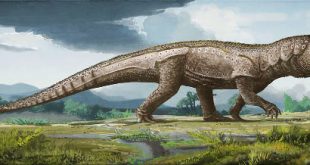
An international team of paleontologists from the Natural History Museum, London, the University of Birmingham and Virginia Tech has formally given an ancient carnivorous reptile a name, over several decades since its fossils were found in Tanzania. The formal species description of Mandasuchus tanyauchen is published in a special memoir …
Read More »Mid-Carnian Mass Extinction Paved Way for Dinosaur Expansion
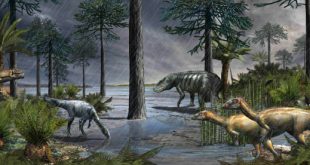
Paleontologists believe that all non-avian dinosaurs were wiped out when a giant asteroid or comet collided with Earth some 65 million years ago, resulting in huge clouds of dust that blocked the Sun’s rays from reaching Earth’s surface. But the origins of dinosaurs have been less understood. In a new …
Read More »New Carnivorous Dinosaur Unveiled: Tratayenia rosalesi
A partial skeleton of a megaraptorid dinosaur unearthed over a decade ago in northwestern Patagonia, Argentina, has been recognized as belonging to a new species. Tratayenia rosalesi crosses a stream in what is now Patagonia, Argentina roughly 85 million years ago. Image credit: Andrew McAfee, Carnegie Museum of Natural History. …
Read More »