October 19, 2019
Paleontogly
A fossil site in Canada has yielded the best-preserved specimen of the dromaeosaurid dinosaur Saurornitholestes langstoni ever found. Saurornitholestes langstoni. Image credit: Jan Sovak. First scientifically described in 1978, Saurornitholestes langstoni is a carnivorous feathered dinosaur within the family Dromaeosauridae (also known as raptors). It lived approximately 76 million years …
Read More »
October 18, 2019
Paleontogly
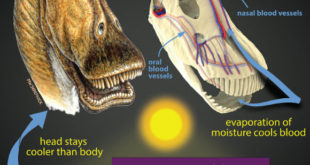
Different groups of gigantic dinosaurs had different thermoregulatory strategies to help moderate brain temperatures in the face of high heat loads, according to new research from the Ohio University’s Heritage College of Osteopathic Medicine. Gigantic dinosaurs like the sauropod Diplodocus, which weighed over 15 tons and was longer than an …
Read More »
October 16, 2019
Paleontogly
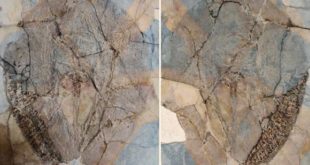
A new species of prehistoric stingray with an exceptional anatomy, which greatly differs from living species, has been identified from fossils found in Italy. Lessiniabatis aenigmatica from the Eocene of Bolca Lagerstätte. Scale bars – 10 cm. Image credit: Marrama et al, doi: 10.1038/s41598-019-50544-y. “Stingrays (order Myliobatiformes) are a very …
Read More »
October 12, 2019
Paleontogly
Paleontologists have announced the discovery of a new genus and species of carcharodontosaurian dinosaur, based on the fossilized remains found in Thailand. Skeletal reconstruction of Siamraptor suwati. Scale bar – 1 m. Image credit: Chokchaloemwong et al, doi: 10.1371/journal.pone.0222489. Dubbed Siamraptor suwati by its discoverers, the newly-discovered dinosaur lived approximately …
Read More »
October 9, 2019
Paleontogly
A previously unknown family, genus and species of microinvertebrates has been found in amber from the Dominican Republic. Nicknamed ‘mold pigs,’ these tiny creatures lived some 30 million years ago (Paleogene period) and had features of both mites and tardigrades. A mold pig (Sialomorpha dominicana). Image credit: George Poinar Jr. …
Read More »
October 9, 2019
Paleontogly
The world’s last population of woolly mammoths (Mammuthus primigenius) lived on Wrangel Island, currently some 140 km off the coast of the Chukotka mainland in northeastern Siberia. They went extinct 3,700 years ago and, according to the frequency of their remains from the island, the extinction was extremely abrupt. In a …
Read More »
October 6, 2019
Paleontogly
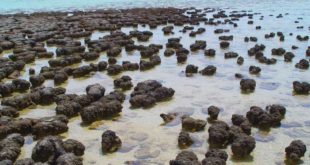
Researchers have found exceptionally preserved organic matter inside samples of rock from the 3.5-billion-year-old Dresser Formation in the Pilbara region of Western Australia. Baumgartner et al provide exceptional evidence for the biogenicity of some of Earth’s oldest stromatolites through preservation of organic matter, including microbial remains, by sulfidization. Image credit: …
Read More »
October 6, 2019
Paleontogly
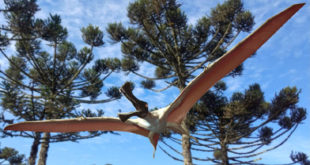
The 96 million-year-old fossilized bones discovered in Queensland, Australia, have been identified as a new genus and species of ornithocheirid pterosaur, Ferrodraco lentoni. Life restoration of Ferrodraco lentoni. Image credit: Travis R. Tischler. Pterosaurs were highly successful reptiles — not dinosaurs, as they’re commonly mislabeled. These creatures thrived from about …
Read More »
September 25, 2019
Paleontogly
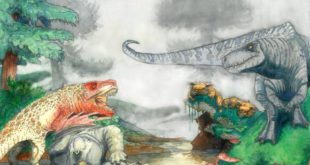
Rauisuchians — predatory crocodile-like creatures that lived during the Triassic period, some 210 million years ago — preyed on early herbivorous dinosaurs and mammal relatives, according to a new study. An artist’s reconstruction of two rauisuchians fighting over a desiccated corpse of a mammal-relative in the Triassic of southern Africa. …
Read More »
September 22, 2019
Paleontogly
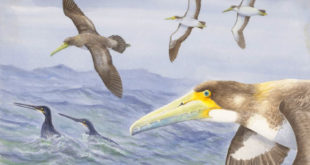
Paleontologists have found the remains of a pelagornithid bird that lived 62 million years ago (early Paleocene epoch) in New Zealand. Protodontopteryx ruthae. Image credit: Derek Onley / Canterbury Museum. Dubbed Protodontopteryx ruthae, the ancient seabird belongs to Pelagornithidae, an ancient family of bony-toothed birds. These seafaring birds were previously …
Read More »