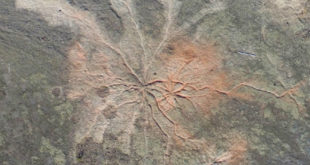
Paleontologists have unearthed the extensive root system of 386-million-year-old (Devonian period) primitive trees in a sandstone quarry near Cairo, New York, the United States. A Devonian root system at the Cairo fossil forest site. Image credit: Stein et al, doi: 10.1016/j.cub.2019.11.067. The Cairo fossil forest covered an area of at …
Read More »Water Lily Genome Sheds Light on Early Evolution of Flowering Plants
An international team of researchers has successfully sequenced and analyzed the genome of the blue-petal water lily (Nymphaea colorata), a plant species that is valued for the aesthetically attractive blue color of petals. The findings, published in the journal Nature, provide insights into the early evolution of the flowering plants …
Read More »Biologists Discover Previously Unknown Cellular Structure in Retina of Insect-Eating Birds
A team of researchers has found a novel retinal structure in the eyes of New World flycatchers. Named the megamitochondria-small oil droplet complex (MMOD complex), this structure may allow these sit-and-wait birds to see their world in a different way from other animals, and help them find and track insect …
Read More »Study: High-Fat Meal Can Silence Communication between Intestine and Rest of the Body
According to a new study performed in zebrafish (Danio rerio), a high-fat meal can shut down the communication between the enteroendocrine cells — specialized sensory cells in the intestinal epithelium that sense and transduce nutrient information — and the rest of the body for a few hours. An enteroendocrine cell …
Read More »Researchers Extract and Sequence Human DNA from 5,700-Year-Old ‘Chewing Gum’
An international team of scientists has successfully sequenced ancient DNA extracted from a 5,700-year-old piece of chewed birch pitch from southern Denmark. In addition to an ancient human genome and mitochondrial DNA (mtDNA), the researchers recovered plant and animal DNA, as well as microbial DNA from several oral species. Further …
Read More »Hubble Gets Its Closest Look Yet at Approaching Interstellar Comet
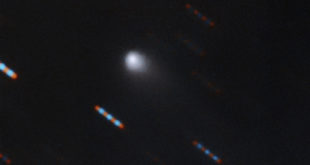
Astronomers have released new photos of comet 2I/Borisov, the second known interstellar visitor to our solar system after ’Oumuamua passed through in 2017. Discovered by amateur astronomer Gennady Borisov, the comet made its closest approach to the Sun on December 8, 2019. NASA has released a pair of photos …
Read More »Cretaceous Feathered Dinosaurs Suffered from Lice
Paleontologists have found tiny nymphs of a previously unknown ancient insect species trapped in two pieces of 99-million-year-old (mid-Cretaceous period) Burmese amber, along with partially damaged dinosaur feathers, the damage of which was probably made by these insects’ feeding behaviors. Mesophthirus engeli nymphs crawled and fed on dinosaur feathers. Image …
Read More »Mars Express Captures New Views of Martian Moon Phobos
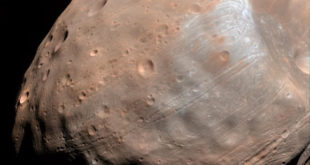
On November 17, 2019, ESA’s Mars Express orbiter made a close flyby of Phobos, the larger and inner of the two natural satellites of Mars. The probe tracked Phobos as the tiny moon passed in front of the spacecraft’s High Resolution Stereo Camera, capturing Phobos’ motions and surface in detail. …
Read More »Juno Spots New Circumpolar Cyclone at Jupiter’s South Pole
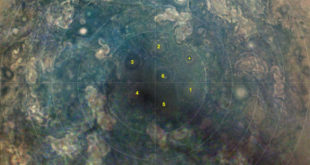
NASA’s Juno spacecraft spied the new Jovian cyclone on November 3, 2019, during its 23rd science pass of the gas giant. A series of JunoCam images from Juno’s 23rd close science pass by Jupiter on November 3, 2019, revealed a sixth circumpolar cyclone in the cluster around Jupiter’s south pole. …
Read More »NASA Chooses Asteroid Landing Zone for OSIRIS-REx Probe
NASA’s OSIRIS-REx space probe reached the asteroid Bennu just over a year ago, and now the agency has decided where it will descend to pick up a sample from the space rock. The site, known as Nightingale, is a gravel-strewn pit near the asteroid’s north pole. It’ll be a …
Read More »