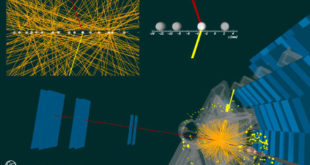
Produce Pairs of Weak-Force Carriers Produce Pairs of Weak-Force CarriersPhysicists from the ATLAS (A Toroidal LHC ApparatuS) Collaboration at CERN’s Large Hadron Collider have observed production of W bosons, elementary particles that carry the weak force, from photons colliding with photons. This new result confirms one of the main predictions …
Read More »Inside the Red Planet
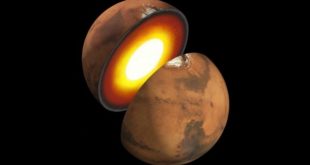
NASA’s InSight Mars Lander Reveals Scientists believe Mars was much more similar to Earth in the distant past, not the dried-up ball of dust it is today. Understanding Mars could help us better understand how planets form, and the NASA InSight mission has the tools to get us there. Using …
Read More »Triassic Aquatic Reptile
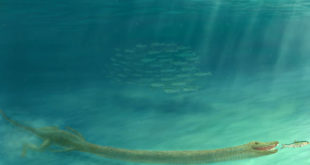
Had Extraordinarily Long Neck Tanystropheus hydroides, the newly-described species of reptile that lived 242 million years ago (Triassic period), was about 6 m (20 feet) long, with the neck making up half of that length — three times as long as its torso. Tanystropheus hydroides. Image credit: Emma Finley-Jacob. One …
Read More »Water Rich World
High-resolution observations from NASA’s Dawn spacecraft of mysterious bright spots (faculae) in Occator crater on the dwarf planet Ceres suggest the existence of a brine reservoir — which is about 40 km (25 miles) deep and hundreds of km wide — that emerged to the surface through long-lived cryovolcanic activity …
Read More »Scientists Rename Genes
So Excel Won’t Reformat Them as Dates Microsoft Excel is an incredibly powerful program that’s just as essential in a laboratory as it is in the average office. However, scientists have had just about enough of Excel renaming genes as if they were dates. It didn’t seem likely anyone would …
Read More »Attack Captured in Amber
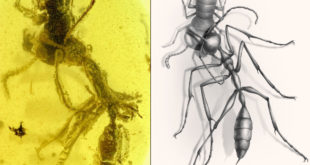
99-Million-Year-Old ‘Hell Ant’ Paleontologists have found trapped in a piece of Burmese amber a unique scene of a prehistoric ‘hell ant’ (subfamily Haidomyrmecinae) attacking a nymph of Caputoraptor elegans, an extinct cockroach relative. The ancient encounter presents some of the first direct evidence showing how the newly-identified hell ant species, …
Read More »Jupiter’s Violent Storms
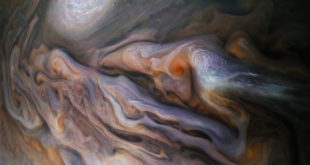
May Form Ammonia-Water Hailstones A new study suggests that during Jupiter’s violent storms, hailstones form from a cooled mixture of water and ammonia gas, similar to the process in Earth’s storms where hail forms in the presence of supercooled liquid water; growth of these Jovian hailstones, dubbed ‘mushballs,’ creates a …
Read More »Sky Pulse in Ultraviolet
Vast Areas of Mars’ Night Sky Pulse in Ultraviolet Using new data from the Imaging Ultraviolet Spectrograph (IUVS) on NASA’s MAVEN (Mars Atmosphere and Volatile Evolution) spacecraft, scientists have found that the atmosphere of Mars pulses in ultraviolet three times per night, and only during Martian spring and fall. The …
Read More »Higgs Boson Muons
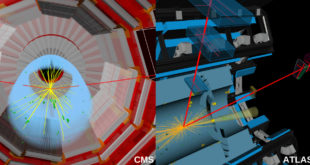
Physicists from the ATLAS (A Toroidal LHC ApparatuS) and CMS (Compact-Muon-Solenoid) collaborations at CERN’s Large Hadron Collider have reported strong evidence for the Higgs boson decay to a pair of muons. Candidate event displays of a Higgs boson decaying into two muons as recorded by CMS (left) and ATLAS (right). …
Read More »Genomeo of Tuatara
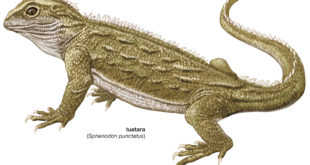
An international team of researchers has sequenced and analyzed the genome of the tuatara (Sphenodon punctatus), the only living member of the reptilian order Rhynchocephalia, once widespread across the ancient supercontinent Gondwana. The tuatara (Sphenodon punctatus). Imager credit: Michael Hamilton, Digitaltrails / CC BY-SA 3.0. The tuatara is an iconic …
Read More »