September 3, 2020
Biology
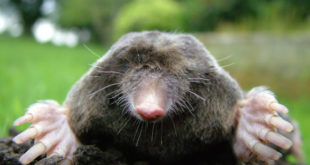
European moles (Talpa europaea) appear to avoid chewing on sand when eating earthworms because it is likely that they find the sensation as repulsive as humans, according to new research from the University of Leicester. The European mole (Talpa europaea). Image credit: Michael David Hill / CC BY-SA 3.0. Professor …
Read More »
September 3, 2020
Physics
Astronomers using the twin LIGO detectors located in Livingston, Louisiana, and Hanford, Washington, and the Virgo detector located near Pisa, Italy, have detected gravitational waves from the most massive binary black hole merger ever discovered. The two spinning black holes merged when the Universe was only about 7 billion years …
Read More »
September 3, 2020
Genetics
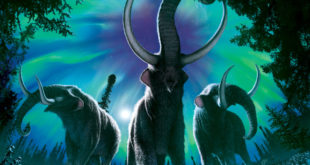
A team of researchers from McMaster University and elsewhere has carried out a phylogeographic study of the extinct American mastodon (Mammut americanum) based on 35 newly-sequenced mitochondrial genomes. Their findings suggest that American mastodons repeatedly expanded into northern latitudes in response to interglacial warming. Artistic rendering of American mastodons (Mammut …
Read More »
September 3, 2020
Space Exploration
A ferric mineral called hematite (Fe2O3) is present at high latitudes on the Moon, mostly associated with east- and equator-facing sides of topographic highs, and is more prevalent on the lunar nearside than the farside, according to an analysis of data collected by the Moon Mineralogy Mapper (M3) onboard India’s …
Read More »
September 1, 2020
Paleontogly
Paleontologists recently found well-preserved dinosaur eggs in an enormous nesting ground of titanosaurian sauropod dinosaurs that lived about 80 million years ago (Cretaceous period) in what is now Patagonia, Argentina. In a paper in the journal Current Biology, they now describe an almost intact embryonic skull from one of these …
Read More »
September 1, 2020
Space Exploration
If you remember even basic elementary school geography, you know that Earth’s surface is mostly water. Scientists have disagreed about how all that water ended up on Earth. Was it all here when the planet formed, or was Earth a dry husk until asteroids and comets delivered water? A …
Read More »
September 1, 2020
Space Exploration
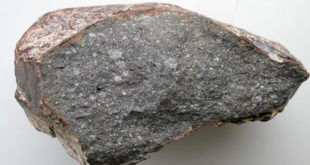
A team of astrobiologists from NASA’s Goddard Space Flight Center and the Carnegie Institution for Science has found a wide diversity of amino acids in Asuka 12236, a carbonaceous chondrite meteorite recovered from the Nansen Ice Field in Antarctica by Belgium and Japan researchers in 2012. This SEM image shows …
Read More »
August 30, 2020
Paleontogly
Scelidosaurus harrisonii, an armored dinosaur that lived around 193 million years ago (Early Jurassic epoch), has been redescribed from a near-complete skeleton discovered over 160 years ago in England. Scelidosaurus harrisonii. Image credit: John Sibbick. Scelidosaurus harrisonii is an early armored ornithischian dinosaur whose remains have, to date, only been …
Read More »
August 30, 2020
Paleontogly
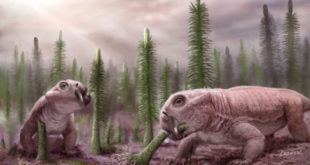
In a paper published in the journal Communications Biology, a team of U.S. paleontologists reports evidence of a hibernation-like condition in Lystrosaurus, an early relative of mammals that lived between 253 and 248 million years ago (Early Triassic epoch). The discovery was enabled by high-resolution of incremental growth marks preserved …
Read More »
August 30, 2020
Space Exploration
A type of meteorite called an enstatite chondrite has similar isotopic composition to terrestrial rocks and thus may be representative of the material that formed Earth. A new study published in the journal Science shows that these meteorites contain sufficient hydrogen to have delivered to Earth at least three times …
Read More »