September 16, 2020
Biology
The whale shark (Rhincodon typus) is the world’s largest fish, growing to maximum known sizes of 18 m (59 feet) total length. A new study led by University of Western Australia marine biologists has found that male whale sharks grow quickly, before plateauing at an average adult length of about …
Read More »
September 16, 2020
Biology
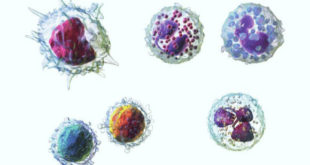
Human white blood cells, or leukocytes, swim using a newly-described mechanism called molecular paddling, according to new research led by University Grenoble Alpes and Aix Marseille University. Five types of human leukocytes. Image credit: Syed H. Shirazi et al, doi: 10.3233/THC-161133. Cells have evolved different strategies to migrate and explore …
Read More »
September 16, 2020
Archeaology
The Canaanite palatial site of Tel Kabri in Israel was severely damaged by a large earthquake around 1700 BCE, which led to its abandonment soon thereafter, according to new research by archaeologists from the University of Haifa and George Washington University. The 3,700-year-old ruins of the wine cellar unearthed at …
Read More »
September 16, 2020
Physics
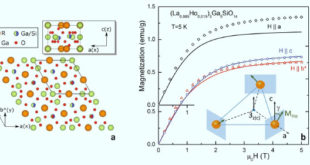
Even small changes in the direction of the magnetic field can switch the electrical properties of a paramagnetic rare-earth material — the holmium-doped langasite (HoxLa3-xGa5SiO14) — to a completely different state, according to new research published in the journal npj Quantum Materials. Crystal structure and magnetism in rare-earth langasite: (a) …
Read More »
September 16, 2020
Physics
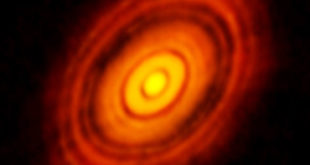
HL Tauri, a young star located 450 light-years away in the constellation of Taurus, is glowing at the center of an system of concentric protoplanetary rings and is producing planets, one for each gap in the ring. Worcester Polytechnic Institute mathematical physicist Dr. Mayer Humi believes HL Tauri provides an …
Read More »
September 15, 2020
Medicine
A researcher at the University of North Carolina School of Medicine has generated scanning electron microscopy images showing startlingly high SARS-CoV-2 viral loads on human bronchial epithelial cells. This SEM image shows SARS-CoV-2 virions (red) produced by human airway epithelia. Image credit: Camille Ehre, doi: 10.1056/NEJMicm2023328. Dr. Camille Ehre from …
Read More »
September 13, 2020
Space Exploration
Charlie Bolden ran NASA from 2009 until early 2017, and before that, he went into space four times as an astronaut. So, when he talks about the Space Launch System (SLS) he oversaw at the agency, you can trust he knows what he’s talking about. In a new interview, …
Read More »
September 13, 2020
Paleontogly
Paleontologists have examined the fossilized remains of a previously unknown species of eurypterid (sea scorpion) and found direct evidence that these marine creatures were able to breathe in subaerial environments through their main respiratory organs. Lamsdell et al present details of the respiratory organs of Adelophthalmus pyrrhae from the Carboniferous …
Read More »
September 13, 2020
Space Exploration
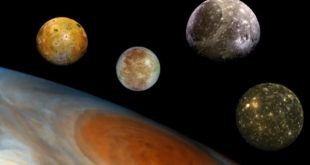
In a process called tidal heating, gravitational push and pull from Jupiter’s Galilean moons — Europa, Ganymede, Io and Callisto — and the gas giant itself stretch and squish the moons enough to warm them. As a result, some of the icy moons contain interiors warm enough to host oceans …
Read More »
September 13, 2020
Space Exploration
Extrasolar planets hosted by stars with sufficiently high carbon-to-oxygen ratios could be made of diamonds and silica, according to new research by Arizona State University and the University of Chicago. An artist’s impression of a carbide planet with diamond and silica as main minerals. Image ctredit: Shim / ASU / …
Read More »