Science

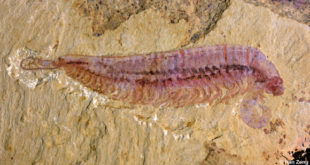
Cambrian Shrimp Five Eyes

Paleontologists in China have uncovered exceptionally preserved fossils of a previously unknown genus and species of extinct arthropod, Kylinxia zhangi, that provides important insights into the phylogenetic relationships among early arthropods, the evolutionary transformations and disparity of their frontal appendages, and the origin of crucial evolutionary innovations in the phylum …

Read More »

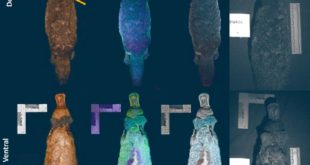
Ultraviolet Fluorescence

The fur of the platypus (Ornithorhynchus anatinus), one of only five extant species of monotremes (egg-laying mammals), absorbs ultraviolet light at wavelengths of 200-400 nm and re-emits visible light, making it fluoresce, according to new research from Northland College and the Warner College of Natural Resources at Colorado State University. …

Read More »

Titan’s Impact Craters

Using the spectral data collected by the Visual and Infrared Mapping Spectrometer (VIMS) onboard NASA’s Cassini spacecraft, a team of researchers has found a mixture of organic materials and water ice in nine impact craters on Titan, the largest moon of Saturn. This colorized radar image, taken by NASA’s Cassini …

Read More »

Fast Radio Bursts

  We know much more about how the universe works today than we did just a few decades ago, but there will always be new mysteries to solve. In recent years, scientists have puzzled over the riddle of fast radio bursts (FRBs). These short-lived electromagnetic beacons can outshine entire galaxies, …

Read More »

New Cynodont Species

Paleontologists have uncovered a previously unknown species of cynodont that lived during the Triassic period in what is now Arizona, the United States. An artist’s impression of Kataigidodon venetus. Image credit: Ben Kligman / Hannah R. Kligman. Cynodonts (clade Cynodontia), literally meaning dog teeth, were one of the most diverse …

Read More »

Duck Billed Dinosaur

An international team of paleontologists has identified a new genus and species of lambeosaurine hadrosaur from fossils dug up in Morocco, North Africa. An artist’s impression of a group of hadrosaurs. Image credit: Raul Martin. The newly-discovered dinosaur, dubbed Ajnabia odysseus, roamed our planet some 66 million years ago during …

Read More »

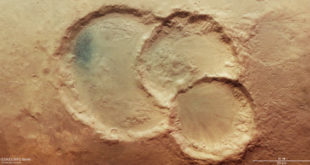
Triple Crater on Red Planet

ESA’s Mars Express orbiter has spotted three overlapping craters in Noachis Terra, an extensive landmass in the southern hemisphere of Mars. This image shows a triple crater in Noachis Terra, Mars. The largest crater measures 45 km across, and the smallest 28 km. There are also signs of other sizeable …

Read More »

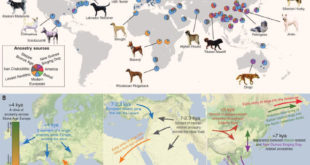
Five Dog Lineages

In a new study published in the journal Science, an international team of scientists sequenced the genomes of 27 ancient dogs, some of which lived up to nearly 11,000 years ago, across Eurasia. The researchers found that dogs likely arose once from a now-extinct wolf population and that by 11,000 …

Read More »

Low Light Foraging Bees

Two Australian bee species, Reepenia bituberculata and Meroglossa gemmata, have adapted their vision for night-time conditions, according to a paper published in the Journal of Hymenoptera Research; both species possess enlarged compound and simple eyes which allow more light to be gathered when compared to their daytime kin. Meroglossa gemmata. …

Read More »

Starlink Speed Tests

  SpaceX has been launching batches of Starlink internet satellites on a regular basis since May 2019, and there are now hundreds of nodes in its megaconstellation. That provides sufficient coverage that SpaceX has started rolling out a beta test of its new satellite internet service. According to data from …

Read More »
Bizwhiznetwork Consultation