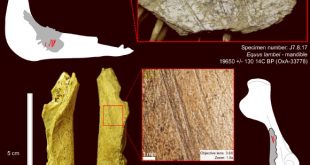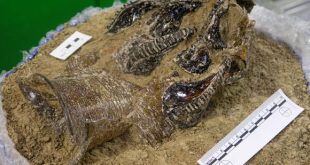
Humans first arrived in North America 10,000 years earlier than previously thought, according to an analysis of ancient animal bones found in northern Yukon, Canada. Top: cut marks on a horse mandible from Bluefish Cave II; the specimen is dated to 19,650 years before present; the bone surface is a …
Read More »Ruby Seadragon Filmed Alive in Ocean for First Time
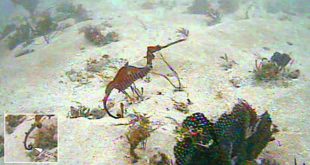
A team of marine biologists from Scripps Institution of Oceanography and the Western Australia Museum has captured on video the first-ever field sighting of the recently-discovered species of seadragon — the ruby seadragon (Phyllopteryx dewysea). The ruby seadragon (Phyllopteryx dewysea) in the Recherche Archipelago, Western Australia. The inset shows a …
Read More »Cassini Captures Breathtaking View of Saturn’s Moon Mimas
This image of Saturn’s seventh largest moon, Mimas, was photographed when NASA’s Cassini spacecraft was approximately 115,000 miles (185,000 km) away. NASA’s Cassini spacecraft obtained this image of Mimas on Oct. 22, 2016. Image credit: NASA / JPL-Caltech / Space Science Institute. Mimas, also known as Saturn I, is the …
Read More »Scientists advance theory that the Moon is made of many smaller moonlets
Theories abound to address how our moon was formed. After we brought moon rocks back from the lunar excursions of the 60s, certain facts became clear, like the striking similarity between Earth’s chemical composition and that of the moon. Like the blind men with the elephant, we’re still at a …
Read More »Hoolock tianxing: New Species of Gibbon Discovered in Myanmar and China
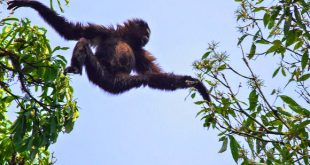
A new species of hoolock gibbon has been discovered in eastern Myanmar and southwestern China by an international team of scientists from the United States, the United Kingdom, China, Australia and Germany. A juvenile male of the Skywalker hoolock gibbon (Hoolock tianxing) from Mt. Gaoligong jumping across trees. Image credit: …
Read More »Study: Endogenous Retroviruses in Genome Important for Human Brain
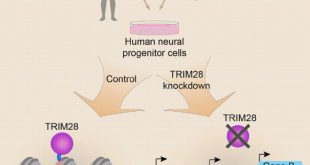
About 8% of the human genome is composed of endogenous retroviruses. According to a new study published in the journal Cell Reports, these retroviruses may have played a significant role in the development of the human brain as well as in various neurological diseases, such as ALS, schizophrenia and bipolar …
Read More »Archaeologists Unearth 1,500-Year-Old Settlement, Precious Jewelry in England
Archaeologists from Oxford Archaeology working at Cherry Hinton in Cambridge, Cambridgeshire, England, have uncovered a wealth of Roman and Anglo-Saxon finds, as well as shed light on the origins of Cherry Hinton itself. The Anglo-Saxon claw beaker. Image credit: Oxford Archaeology. The archaeological team, working on behalf of CgMs and …
Read More »Hyoliths: Mysterious Cambrian Animals Classified as Lophophorates
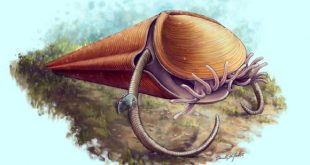
Paleontologists have finally determined what hyoliths — a group of extinct marine creatures — actually are. Reconstruction of the hyolith Haplophrentis on the Cambrian sea floor. Image credit: D. Dufault / Royal Ontario Museum. Hyoliths evolved over 530 million years ago during the Cambrian period and are among the first …
Read More »Stem Cell-Based Transplantation Approach Improves Vision in End-Stage Retinal-Degeneration Mice
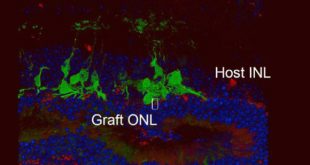
In the Jan. 10 issue of the journal Stem Cell Reports, Dr. Michiko Mandai and colleagues at the RIKEN Center for Developmental Biology in Japan report that transplantation of induced pluripotent stem cell (iPSC)-derived retinal tissue improved vision in a mouse model of end-stage retinal degeneration. 3D observation of contact …
Read More »Bryanites graeffii: New Beetle Species Described from 150-Year-Old Museum Specimen
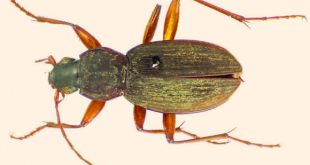
A new species of ground beetle has been identified by Cornell University Professor James Liebherr. Holotype specimen of Bryanites graeffii. Image credit: J.K. Liebherr. “Bryanites graeffii is described from Samoa based on a single male specimen collected between 1862-1870 that was recently discovered in the Muséum national d’Histoire naturelle, Paris,” …
Read More »