Genetic variants linked to Alzheimer’s disease and heavy smoking are less frequent in people with longer lifespans, suggesting that natural selection is weeding out these unfavorable variants in some populations, according to an analysis of the genomes of 210,000 people in the U.S. and UK. Mostafavi et al found a …
Read More »Research Sheds New Light on Biology of Extinct Cave Bear
According to new research from the University of Zürich, the cave bear (Ursus spelaeus) — one of the biggest bear species in history — had an unusually small brain relative to its body size. Reconstruction of the cave bear (Ursus spelaeus). Image credit: Sergio de la Larosa / CC BY-SA …
Read More »Study: Olfaction is Key Factor in Bird Navigation
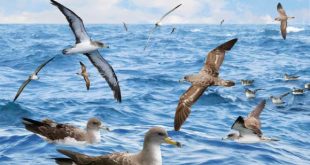
Olfaction (sense of smell) is a key factor in long-distance oceanic navigation in birds, according to a new University of Oxford-led study. Cory’s shearwaters from the Crossley ID Guide Britain and Ireland. Image credit: Richard Crossley / CC BY-SA 3.0. “Navigation over the ocean is probably the extreme challenge for …
Read More »Study: Circadian Rhythm Gene Variants Increase Risk of Migraines from Financial Hardship
Researchers have shown that financial stress may cause more migraines in individuals with variants in the circadian rhythm gene CLOCK, suggesting that the genetics of circadian rhythms and presence of chronic stresses interact to influence the likelihood of migraine problems. Migraines take a toll on around 1 billion people. This …
Read More »Olive Oil-Enriched Dark Chocolate Improves Cardiovascular Risk Profile
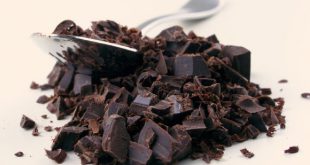
A new study from University of Pisa researchers has found that small daily portions of extra virgin olive oil-enriched dark chocolate are associated with an improved cardiovascular risk profile. Dark chocolate with extra virgin olive oil is associated with an improved cardiovascular risk profile. Image credit: Juergen Brandes. “A healthy …
Read More »Antarctic Plesiosaur Filtered Food Like Modern Baleen Whales
In 1984, Texas Tech University paleontologists Sankar Chatterjee and Bryan Small unearthed the fossilized skull of a previously unknown marine reptile on Seymour Island in Antarctica. While it was obviously a plesiosaur, Morturneria seymourensis was unlike any previously found. Now, three decades later, Professor Chatterjee and colleagues have made a …
Read More »Asteroid Florence Has Two Small Moons, NASA Radar Reveals
Astronomers working with NASA’s 230-foot (70-m) Deep Space Network antenna in Goldstone, CA, have released the first radar images of the near-Earth asteroid (3122) Florence. The images show the asteroid has two small moons. This radar image shows the near-Earth asteroid Florence and its two moons. Image credit: NASA / …
Read More »New Ostrich-Like Dinosaur Discovered in Mongolia: Aepyornithomimus tugrikinensis
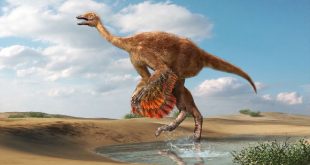
Paleontologists have found fossil fragments from a new species of ornithomimosaur (ostrich-mimic dinosaur) that walked the Earth between 84 and 72 million years ago. Aepyornithomimus tugrikinensis. Image credit: Masato Hattori. Called Aepyornithomimus tugrikinensis, the new dinosaur is a type of ornithomimosaur (Ornithomimidae), a group of theropods that evolved a toothless …
Read More »JAXA’s Akatsuki Orbiter Spots Equatorial Jet in Venus’ Atmosphere
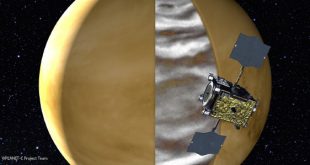
New observations from Akatsuki, a robotic spacecraft launched by the Japan Aerospace Exploration Agency (JAXA) in 2010 to orbit Venus, have revealed an equatorial jet in the lower-to-middle cloud layer of the planet’s hostile atmosphere. An illustration of JAXA’s Akatsuki orbiter successfully tracking lower-altitude clouds during the night with its …
Read More »Study: Cocoa Compounds Help Cells Release More Insulin
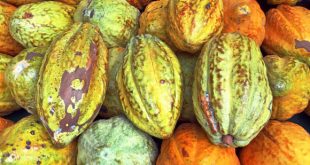
When a person has diabetes, their body either doesn’t produce enough insulin or doesn’t process blood sugar properly; at the root of that is the failure of ?-cells (beta cells), whose job is to produce the sugar-regulating hormone insulin. A Brigham Young University-led study finds beta cells work better and …
Read More »