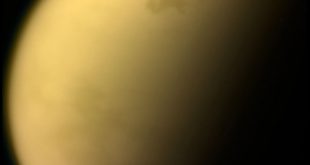
Planetary researchers with NASA’s Cassini mission have detected a cloud of toxic hybrid ice high above the south pole of Saturn’s hazy moon, Titan. This view of Titan is among the last images NASA’s Cassini spacecraft sent to Earth before it plunged into the giant planet’s atmosphere. Image credit: NASA …
Read More »Plasma Technology Could Hold Key to Creating Oxygen Supply on Mars
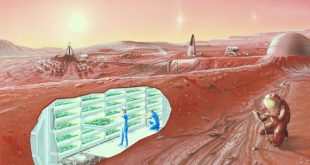
A study published in the journal Plasma Sources Science and Technology argues that Mars, with its 96% carbon dioxide (CO2) atmosphere, has nearly ideal conditions for CO2 decomposition by non-thermal (non-equilibrium) plasmas. Artist’s concept of a colony on Mars. Image credit: NASA. Mars has resources that can be used for …
Read More »See solar eclipse 2017 live video from NASA on Facebook
NASA; Caleclipse.org When you open Facebook on August 21, an unique message from the company will welcome you about the total solar eclipse. “On August 21st, the United States will experience the first coast-to-coast overall solar eclipse in 99 years, making this the most important huge event in the social …
Read More »Powerful Solar Storms Could Electrically Charge Mars’ Moon Phobos
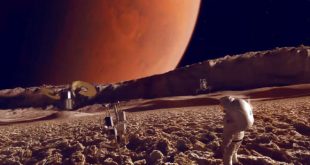
A new study published in the journal Advances in Space Research suggests that solar storms create a complex electrical environment around Phobos, giving its night side and shadowed craters a static electric charge. This artist’s conception shows an astronaut and spacecraft on the Martian moon Phobos. Image credit: NASA. Phobos, …
Read More »Massive Volcanic Eruptions Linked to Revolts in Ptolemaic Egypt
A Yale University-led study suggests that abrupt shifts in climate caused by massive volcanic eruptions helped to trigger poorly understood revolts — such as the great 20-year Theban revolt — and other political upheaval in Ptolemaic Egypt. This piece of papyrus from the mid-third century BC describes a period of …
Read More »Wildlife Biologists Find American Alligators Eat Small Sharks and Stingrays
A new study published in the journal Southeastern Naturalist is the first to document that American alligators (Alligator mississippiensis) on the Atlantic and Gulf coasts occasionally eat three shark species and one species of stingray. An American alligator (Alligator mississippiensis) caught a nurse shark in the Ding Darling National Wildlife …
Read More »New Theory Explains Why Our Universe is Three-Dimensional
According to a new theory proposed by University of Edinburgh Professor Arjun Berera and colleagues, shortly after the Universe came into existence it was filled with ‘knots’ formed from flexible strands of energy called flux tubes that link elementary particles together. This is a graphic depicting formation of flux tube …
Read More »Programmable Liquid Matter: Researchers Find Way to Morph Liquid Metal into Physical Shapes
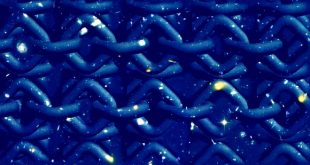
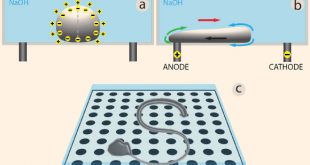
University of Sussex researcher Yutaka Tokuda and co-authors have applied electrical charges to manipulate liquid metal into 2D shapes such as letters and a heart. The findings, reported at the 2017 ACM International Conference on Interactive Surfaces and Spaces in Brighton, the United Kingdom, represent an ‘extremely promising’ new class …
Read More »54-Million-Year-Old Sea Turtle Hatchling Reveals Ancient Sun Protection
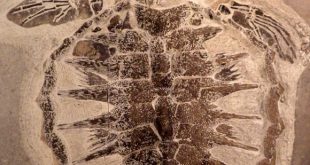
An international team of paleontologists from the United States, Sweden, and Japan has retrieved original pigment, beta-keratin and muscle proteins from a hatchling of Tasbacka danica, a species of sea turtle that lived during the Eocene epoch. Published in the journal Scientific Reports, the study provides direct evidence that a …
Read More »Scientists Detect Gravitational Waves from Colliding Neutron Stars
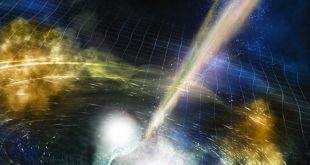
The LIGO Scientific Collaboration, Virgo Collaboration, and their partners have directly detected gravitational waves — ripples in space and time — from a pair of inspiraling neutron stars. Named GW170817, the event was not only ‘heard’ in gravitational waves but also seen in light by dozens of space- and ground-based …
Read More »