October 30, 2017
Medicine
Researchers from the European project ‘Automatic Detection of VAscular Networks for Cancer Evaluation’ (ADVANCE) have developed the world’s first scanner that detects blood vessels grown by a malignant melanoma with an infrared laser beam in 30 seconds. Current skin cancer diagnosis can last a number of weeks and be very …
Read More »
October 30, 2017
Genetics
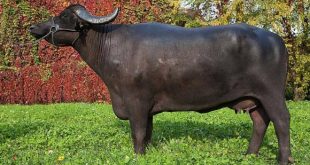
A multinational consortium of scientists has produced the first high-quality genomic sequence for the river buffalo (Bubalus bubalis bubalis), an important species for agriculture and local economies. This is Olimpia da Farfengo, the female Mediterranean water buffalo that the researchers sequenced. Image credit: Caterina Cambuli. The water buffalo is a …
Read More »
October 30, 2017
Space Exploration
Ceres’ crust, with its mixture of ice, salts and hydrated materials, represents most of the dwarf planet’s ancient ocean, according to two new studies from NASA’s Dawn mission. This false-color image shows the dwarf planet Ceres. Image credit: NASA / JPL-Caltech / UCLA / MPS / DLR / IDA. The …
Read More »
October 28, 2017
Paleontogly
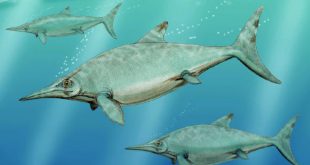
According to a new study released this week, a fossil found in the Indian state of Gujarat represents the first nearly complete skeleton of an ichthyosaur from India and the first record from the Jurassic of this country. Ichthyosaurs. Image credit: Dmitry Bogdanov / CC BY 3.0. Ichthyosaurs were predatory …
Read More »
October 27, 2017
Paleontogly
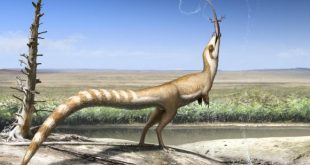
University of Bristol paleontologists and natural history artist Robert Nicholls have revealed how Sinosauropteryx prima — a small theropod dinosaur that lived about 125 million years ago (Early Cretaceous epoch) in what is now China — used its color patterning, including a bandit mask-like stripe across its eyes and a …
Read More »
October 27, 2017
Genetics
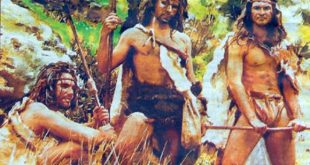
The aboriginal inhabitants of the Canary Islands, commonly known as Guanches, were genetically most similar to modern North African Berbers, according to an ancient-DNA sequencing study published this week in the journal Current Biology. Guanches. Image credit: Gran Enciclopedia Virtual de las Islas Canarias. When and how the Guanches arrived …
Read More »
October 26, 2017
Paleontogly
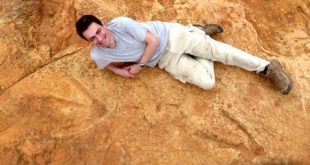
Footprints of a previously unknown, very large carnivorous dinosaur have been found on an ancient land surface — known as a palaeosurface — in the Maseru District of Lesotho, Africa. Dr. Knoll lies next to the exceptionally large carnivorous dinosaur footprints found in Lesotho. Image credit: Fabien Knoll. The newly-discovered …
Read More »
October 26, 2017
Paleontogly
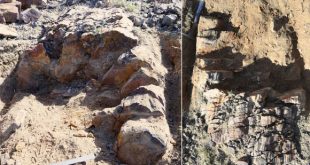
Massive, exceptionally well-preserved cladoxylopsid tree trunks found in Xinjiang, China, have revealed an interconnected web of woody strands (xylem) within the trunk of the tree that is much more complex than that of the living trees. Xinicaulis lignescens. The largest silicified trunk in the field, with a maximum diameter of …
Read More »
October 26, 2017
Medicine
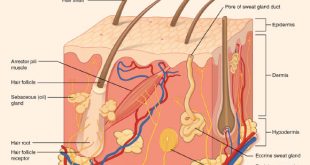
In a new study published in the journal eLife, Dr. Andrew Cowburn of the University of Cambridge and co-authors show that skin helps regulate blood pressure and heart rate in response to changes in the amount of oxygen available in the environment. Structure of the skin. Image credit: OpenStax College …
Read More »
October 26, 2017
Space Exploration
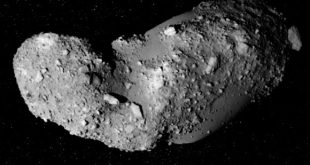
New research has shed light on the collisional history of one of the most famous asteroids. Itokawa’s curious, varied terrain and lack of impact craters indicate it is a rubble pile asteroid. Image credit: Japan Aerospace Exploration Agency. Asteroid 25143 Itokawa is a near-Earth, rubble-pile asteroid, measuring 535 m x …
Read More »