In a new study, Professor Gerald Shulman of the Howard Hughes Medical Institute at Yale and colleagues show that just three days of a very-low-calorie diet (VLCD) improve glucose metabolism before weight loss in a rat model of type 2 diabetes, and trace the beneficial metabolic effects to improved liver …
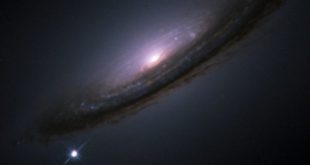
Read More »Astronomers Find Star That Has Exploded Six Times
Supernova are some of the oldest recorded astronomical phenomena in human history. In 185 AD, Chinese astronomers recorded the appearance of a star that appeared suddenly in the night sky, did not move like a comet, and was visible for eight months before fading again. Over 2,000 years the Chinese …
Read More »Sheep Have Exceptionally High Face-Recognition Abilities, News Study Reveals
According to a new study published in the journal Royal Society: Open Science, sheep can be trained to recognise familiar and unfamiliar human faces from photographic portraits. Sheep recognize familiar and unfamiliar human faces from 2D images. Image credit: Magnus114. Human face recognition is a critical social skill. Humans recognize …
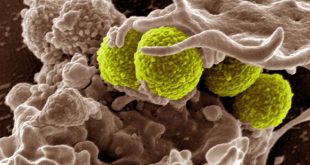
Read More »Chemists Synthesize Two Simplified Forms of Superbug-Killing Antibiotic Teixobactin
An international team of researchers led by the University of Lincoln, UK, has produced two simplified versions of teixobactin, a powerful natural antibiotic which many in the scientific community believe could lead to creation of the first commercially viable new antibiotic drug in three decades. Teixobactin eliminates MRSA, Mycobacterium tuberculosis, …
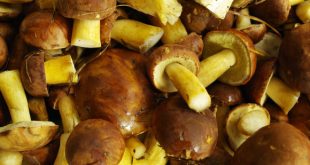
Read More »Study: Mushrooms Contain Powerful Antioxidants with Anti-Aging Potential
Certain mushroom species are high in two antioxidants — glutathione and ergothioneine — that may help with anti-aging treatments and strategies, according to a new study published in the journal Food Chemistry. Mushrooms contain unusually high amounts of antioxidants called glutathione and ergothioneine. Image credit: Jan Plywacz. “We found that …
Read More »“Missing Link” In Chemistry Might Discuss The Origin Of Life On Earth
The question of how chemistry ended up being biology– arguably the most awesome scientific concern of our time– has plenty of responses, however none are definitive. Researchers aren’t even sure how DNA and RNA, DNA’s chemical “cousin”, came about.Although there are some engaging concepts being thrown about, even the collection …
Read More »Newly Developed Metasurface Generates Structured Light Beams
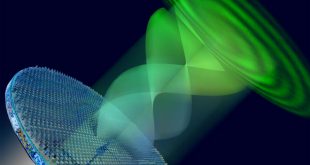
A team of researchers has developed a new tool that can produce complex states of light. The research appears in the journal Science. A metasurface uses circularly polarized light to generate and control new and complex states of light, such swirling vortices of light. Image credit: Second Bay Studio / …
Read More »Archaeologists Unearth Sasanian-Period Loom in Iraq
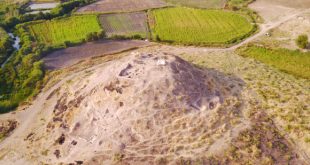
A team of Near Eastern archaeology students led by Goethe University Professor Dirk Wicke has uncovered the burnt remains of a Sasanian loom, about 1,500 years old, at the archaeological site of Gird-i Qalrakh in the province of Sulaymaniyah, northern Iraq. Aerial view of the site of Gird-i Qalrakh from …
Read More »Enceladus’ Highly Porous Core Keeps Its Subsurface Ocean Warm, New Study Says
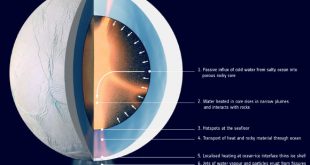
A new modeling study led by the University of Nantes is the first to explain several key characteristics of Saturn’s moon Enceladus observed by NASA’s Cassini spacecraft: a global ocean underneath the moon’s ice shell, internal heating, thinner ice at the south pole, and hydrothermal activity. This graphic illustrates how …
Read More »Paleontologists Discover Two Mammals from Early Cretaceous Epoch
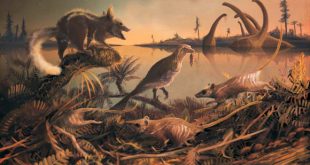
A group of paleontologists from the University of Portsmouth has discovered two new species of mammals that lived 145 million years ago in what is now Dorset county, southern England. Artist’s impression of a lagoon at dusk with Durlstodon ensomi (left foreground), Durlstotherium newmani (right and center foreground) and the …
Read More »