NASA retired the Space Shuttle in 2011 and embarked on two projects that would eventually restore its access to space. There’s the Commercial Crew Program, which recently led to the SpaceX Dragon successfully transporting astronauts to and from the International Space Station. The Space Launch System (SLS), which is …
Read More »Archosauriform Footprints
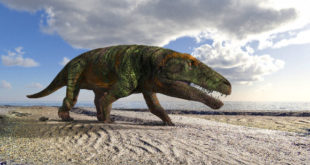
Paleontologists in Italy have discovered an assemblage of fossil footprints left by an Early Triassic archosauriform. Life appearance of the non-archosaurian archosauriform, the most suitable producer of Isochirotherium gardettensis. Image credit: Fabio Manucci. The archosauriform footprints were spotted at a paleontological site on the Gardetta Plateau in the Western Alps, …
Read More »Physicists Extract Energy
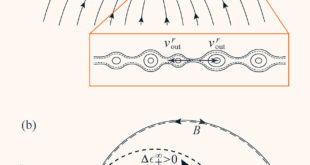
Spinning black holes store rotational energy that can be extracted; when a black hole is immersed in an externally supplied magnetic field, reconnection of magnetic field lines within the ergosphere can generate negative energy particles that fall into the black hole event horizon while the other accelerated particles escape stealing …
Read More »Long Sought Axions
First theorized in the 1970s, axions are hypothetical particles that were proposed to preserve a time-reversal symmetry of the nuclear force. These particles may make up dark matter and may be produced thermally inside the cores of neutron stars, escape the stars due to their feeble interactions with matter, and …
Read More »Ancient Maya Flasks
A team of archaeologists from the United States and Mexico have detected mixtures of tobacco and a non-tobacco plant called the Mexican marigold (Tagetes lucida) in residues taken from a collection of 14 pre-Columbian Maya bottle-shaped containers known as flasks. The discovery paints a clearer picture of ancient Maya drug …
Read More »Volta’s Electric Eels
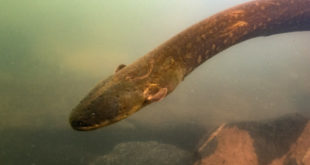
New observations made near the mouth of a small lake on the banks of the Iriri River in Brazil’s state of Pará show Volta’s electric eels (Electrophorus voltai) herding, encircling shoals of small fishes called tetras, and launching joint predatory high-voltage strikes on the prey ball. The observations, described in a …
Read More »Jurassic Period Shark
An international team of paleontologists from Austria and Switzerland has uncovered an exceptionally well-preserved skeleton of Asteracanthus ornatissimus, a species of hybodontiform shark that lived about 150 million years ago (Jurassic period), in the famous limestones of Solnhofen in Germany. Tentative life reconstruction of the hybodontiform shark Asteracanthus ornatissimus. Image …
Read More »Dire Wolves Years Ago
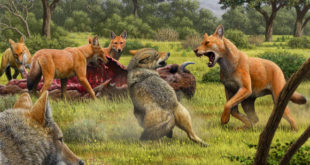
Dire wolves (Canis dirus) are considered to be one of the most common and widespread large carnivores in Pleistocene America, yet relatively little is known about their evolution or extinction. Previous analyses, based on morphology alone, had led scientists to believe that these long-extinct canids were closely related to modern …
Read More »Supermassive Black Hole
Astronomers have discovered about 750,000 quasars, which are among the brightest and most energetic objects in the universe. Despite its uninspiring designation, J0313-1806 is distinct from other quasars. This recently spotted object is the oldest known quasar in the universe, with a supermassive black hole more than 13 billion …
Read More »Warty Pig Painting
A team of archaeologists from Australia and Indonesia has discovered two figurative paintings of the Sulawesi warty pig (Sus celebensis) — a species of small (40 to 85 kg), short-legged pig with characteristic facial warts — in Leang Tedongnge and Leang Balangajia 1 caves on the Indonesian island of Sulawesi. …
Read More »