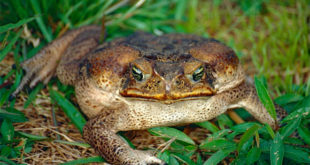
An international team of scientists has sequenced and analyzed the draft genome of the cane toad (Rhinella marina), a poisonous amphibian native to Central and South America that has spread across many regions of the globe. The findings appear in the journal GigaScience. A cane toad (Rhinella marina), adult female. …
Read More »Severe Scoliosis Linked to Essential Dietary Mineral Manganese
A research team led by Washington University scientists has found that children with severe scoliosis are twice as likely as children without the disease to carry a gene variant that makes it hard for their cells to take in and use manganese. The findings are published in the journal Nature …
Read More »Groundcherry Could Be Agriculture’s Next Big Berry Crop
The groundcherry (Physalis pruinosa), also called ‘husk cherry’ and ‘strawberry tomato,’ is native to Central and South America. This tropical-tasting fruit is approximately the same size as a cherry tomato, but with a much sweeter flavor. It contains vitamins B and C, beta-carotene, phytosterols and antioxidants, and has anti-inflammatory and …
Read More »JAXA’s Hayabusa-2 Spacecraft Snaps Close-Up Photo of Asteroid Ryugu
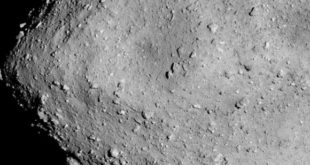
The Japan Aerospace Exploration Agency (JAXA) has revealed a stunning close-up shot of the asteroid Ryugu captured by its Hayabusa-2 spacecraft. Hayabusa-2 image of the asteroid Ryugu as seen from a distance of 3.7 miles. A particularly large crater is visible near the center of the image. Image credit: JAXA …
Read More »True Colors of Pluto and Its Largest Moon Charon
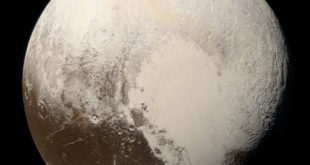
Marking the anniversary of New Horizons’ historic flight through the Pluto system on July 14, 2015, NASA released high-resolution natural-color images of Pluto and Charon. Pluto in true color. Image credit: NASA / Johns Hopkins University Applied Physics Laboratory / Southwest Research Institute / Alex Parker. These color images result …
Read More »Planets Don’t Need Plate Tectonics to Be Habitable
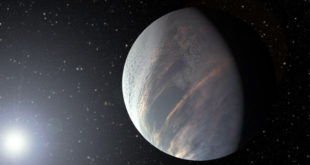
There may be more habitable exoplanets than we previously thought, according to Pennsylvania State University researchers Bradford Foley and Andrew Smye, who suggest that plate tectonics are in fact not necessary. Their work is published in the journal Astrobiology. An artist’s impression of a potentially habitable exoplanet. Image credit: Sci-News.com. …
Read More »NASA’s Parker Solar Probe Launches Successfully
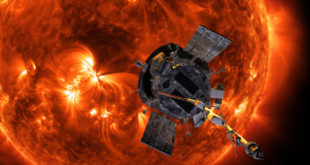
NASA’s Parker Solar Probe launched yesterday (August 12) from Space Launch Complex-37 at Cape Canaveral Air Force Station in Florida, rising off the pad atop a United Launch Alliance Delta IV Heavy rocket at 3:31 a.m. EDT. At 5:33 a.m. EDT, the mission operations manager reported that the car-sized spacecraft …
Read More »4.56-Billion-Year-Old Igneous Meteorite Contains Clues to Planetary Building Blocks
Northwest Africa (NWA) 11119, a stone meteorite found in December 2016 in Mauritania, is the world’s oldest igneous meteorite, according to new research. An artist’s rendition of NWA 11119 (far right bottom corner of illustration), the oldest-ever igneous meteorite. Image credit: University of New Mexico. “The age of NWA 11119 …
Read More »Researchers Find Direct Evidence of Water Ice in Moon’s Polar Regions
A team of researchers led by Dr. Shuai Li of the University of Hawaii and Brown University has directly observed definitive evidence of surface-exposed water ice in the lunar polar regions. The distribution and abundance of the lunar ice are distinct from those on other airless bodies in the inner …
Read More »Magnetic Fields Impact Atmospheric Circulation of Gaseous Planets, Scientists Find
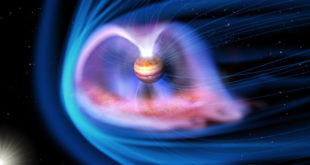
A team of researchers from the Australian National University and the Lawrence Livermore National Laboratory has solved the mystery underlying Jupiter’s colored bands in a study on the interaction between atmospheres and magnetic fields. Magnetic fields around Jupiter can overpower zonal jets that affect atmospheric circulation. Image credit: JAXA. Jupiter …
Read More »