Paleontologists in Argentina have found a fossilized jaw of the extinct bat species Desmodus draculae inside an ancient burrow of a giant sloth. Desmodus draculae in a burrow of a giant sloth. Image credit: Daniel Boh / Museo de Ciencias Naturales de Miramar. Desmodus draculae is an extinct species of …
Read More »Lepton Flavor Universality
Physicists from the ATLAS Collaboration at CERN’s Large Hadron Collider (LHC) have successfully performed measurements of ‘lepton flavor universality,’ a fundamental principle of the Standard Model of particle physics. Their results are the first such measurement from LHC, and the most precise one to date, surpassing the precision obtained from …
Read More »Chocolate in the Morning
A new study, led by Brigham and Women’s Hospital scientists, suggests that having chocolate in the morning or in the evening/night results in differential effects on hunger and appetite, lipid oxidation, fasting glucose, microbiota, and sleep and temperature rhythms; the consumption of a rather high amount of chocolate (100 g) …
Read More »Songbirds Can Taste Sugar
Seeing a bird eat nectar from a flower is a common sight in our world. The ability to detect sugars, however, is not ancestral in the bird lineage, where most ancient species were carnivorous. In a new study published today in the journal Science, an international team of researchers looked …
Read More »European Water Vole
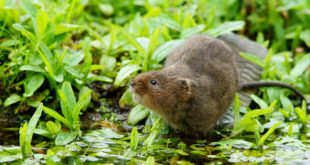
A team of UK researchers has decoded the complete genome of a semi-aquatic mammal called the European water vole (Arvicola amphibius). The European water vole (Arvicola amphibius). Image credit: Peter Trimming / CC BY 2.0. The European water vole is a small semi-aquatic rodent native to Europe and Asia. Often …
Read More »Quark-Gluon Plasma
Quark-gluon plasma is a state of dense matter with the quarks and gluons being its constituents. Soon after the Big Bang the matter was just in such a phase. When the Universe was expanding and cooling down the quark-gluon plasma turned into hadrons (neutrons and protons), which further formed the …
Read More »Daylight Saving Time
According to a new paper published this week in the journal Scientific Reports, people whose genetic profile makes them more likely to be ‘early birds’ the rest of the year can adjust to the Daylight Saving Time change in a few days; but those who tend to be ‘night owls’ …
Read More »Ancient Woodlice
Paleontologists have performed a complete re-analysis of Oxyuropoda ligioides, a land-based peracarid crustacean first reported in 1908 from the Late Devonian floodplains of Ireland and left with unresolved systematic affinities despite a century of attempts at identification. Oxyuropoda ligioides in its 365-million-year-old continental environment (Kiltorcan, Kilkenny, Ireland). Image credit: Diane …
Read More »New Types of Glial Cells
The two novel types of neuroglial cells — usually referred to simply as glial cells or glia — may play an important role in brain plasticity and repair, according to new research led by the University of Basel. A glial cell of new type (green), arising from adult stem cells …
Read More »Telescope’s Winged Mirror
NASA has been working on the James Webb Space Telescope (JWST) for the better part of two decades, and it’s almost ready for launch. When operating in space, the JWST will be the most powerful telescope ever built, but it’ll all be for naught if the giant segmented mirror …
Read More »