An international team of scientists has found a wealth of well-preserved stony meteorites in the Atacama Desert that allowed them to reconstruct the rate of falling meteorites over the past two million years. Meteorite with thin, dark, fusion crust in the Atacama Desert, Chile. Image credit: Jérôme Gattacceca, CEREGE. “Our …
Read More »50% of U.S. Children and Adolescents Have Ideal Cholesterol Levels, Study Finds
According to new research, levels of high-density lipoprotein (HDL), non-HDL and total cholesterol in U.S. youths have improved from 1999 to 2016, but only 50% of children and adolescents are in the ideal range, and 25% are in the clinically high range. Between 1999 and 2016, favorable trends were observed …
Read More »Physicists Determine Geometry of Electrons in Quantum Dots
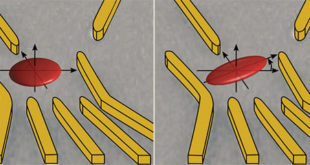
A team of physicists at the University of Basel has experimentally mapped out the shape and orientation of electrons trapped in quantum dots. An electron is trapped in a quantum dot, which is formed in a 2D gas in a semiconductor wafer. However, the electron moves within the space and, …
Read More »Researchers Brew Beer with 5,000-Year-Old Yeasts
A multidisciplinary team of scientists has successfully isolated several yeast strains from ancient vessels excavated at archaeological sites in Israel. The researchers then brewed ‘aromatic and flavorful’ beer using the ancient yeast strains. Beer cruse from Tell es-Safi/Gath, Israel. Image credit: Yaniv Berman / Israel Antiquities Authority. “We hypothesized that …
Read More »NASA Orders First Segment of Lunar Station for 2024 Artemis Moon Mission
NASA is going back to the Moon, and this time, it intends to stay a while. That’s the news from NASA Administrator Jim Bridenstine, who announced the first company chosen to deliver a vital component of the space agency’s Lunar Gateway space station. Maxar Technologies will build the power …
Read More »Moon’s Nearside-Farside Asymmetries are Result of Ancient Giant Impact, Says New Study
The Moon has striking asymmetries between its nearside and farside in topography, crustal thickness, and composition. A new study, published in the Journal of Geophysical Research: Planets, suggests these asymmetries were caused by a dwarf planet colliding with the Moon in the early history of the Solar System. Global map …
Read More »Young Women Have Higher Gut Bacterial Diversity than Young Men
In a new study in the journal mSystems, an international team of researchers analyzed the relationship of age and sex to gut bacterial diversity in adult cohorts from four geographic regions. They found that younger age is positively associated with gut bacterial diversity in both men and women, but young …
Read More »Paleontologists Find One-Billion-Year-Old Fossil Fungi in Canada
An international team of paleontologists has discovered 1,000- to 900-million-year-old microfossils of a fungus in estuarine shale of the Grassy Bay Formation in Arctic Canada. These multicellular organic-walled microfossils are more than half a billion years older than previously reported occurrences of fungi. Microphotograph of Ourasphaira giraldae. Image credit: Loron …
Read More »Early Modern Humans Cooked and Ate Starchy Food
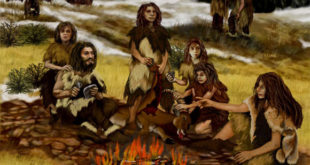
An international team of researchers has found numerous fragments of charred starch plant tissues in 120,000-year-old hearths at the archaeological site of Klasies River, the complex of caves and rock shelters located on the Tsitsikamma coast between Port Elizabeth and Plettenberg Bay in South Africa. This new evidence supports the …
Read More »Planetary Researchers Create Atlas of Moon’s South Pole
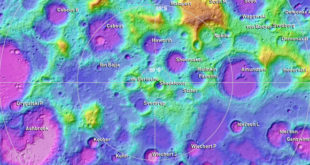
To assist NASA and the lunar community, a team of researchers from the Lunar and Planetary Institute (LPI) has compiled an online atlas that consists of a series of maps, images, and illustrations of the Moon’s south polar region. Topographic map of the Moon’s south pole (80°S to pole). Image …
Read More »