Science

Daily Pecan Consumption

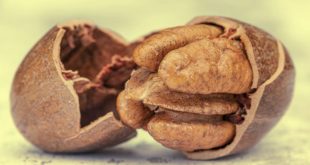
In a new randomized, controlled trial, participants at risk for cardiovascular disease who ate pecans (Carya illinoinensis) during an eight-week intervention showed significant improvements in total cholesterol, triglycerides and low-density lipoprotein (LDL) cholesterol. Guarneiri et al. saw an average drop of 5% in total cholesterol and between 6% and 9% …

Read More »

Trehalulose Rich Honey

Organic chemists at the University of Queensland have found that an unusual bioactive disaccharide called trehalulose, which is a feature of stingless bee honey, while not dominant in any other foods, is produced in the gut of stingless bees. Tetragonula carbonaria combs. Image credit: Tobias Smith. Stingless bees belong to …

Read More »

Fish Neck-Like Motion

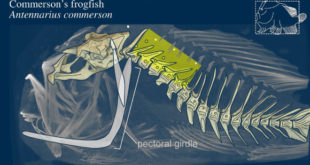
Trout and frogfish can bend their spines and heads upwards, despite having different anatomy from humans and other land-dwelling vertebrates, according to a study by University of Liverpool’s Dr. Ariel Camp. Craniovertebral skeleton of the Commerson’s frogfish (Antennarius commerson). Image credit: Ariel L. Camp, doi: 10.1098/rspb.2021.1091. Dr. Camp used X-ray …

Read More »

Appalachian Dinosaurs

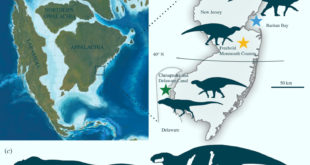
Chase Doran Brownstein from the Department of Ecology and Evolutionary Biology at Yale University and the Stamford Museum and Nature Center has described two new dinosaurs — a herbivorous hadrosaur and a carnivorous tyrannosaur — that lived in the North American paleolandmass Appalachia during the Late Cretaceous epoch, some 85 …

Read More »

Tardigrades Resembling Insects

Tardigrades utilize a tetrapod-like stepping pattern remarkably similar to that observed in insects, despite significant disparities in size and skeletal structure between the two groups, according to new research led by scientists from Rockefeller and Princeton Universities. Hypsibius exemplaris. Image credit: Tarushika Vasanthan & Jonathon Stone, doi: 10.22120/jwb.2020.96855.1037. The vast …

Read More »

Tyrannosaurus Rex’s Jaw

Paleontologists have analyzed the morphology of the neurovascular canal in the well-preserved jaw of Tyrannosaurus rex using computed tomography techniques. Their results show that the dinosaur’s neurovascular canal had a rather complex branching amongst the dinosaurs and that its complexity was comparable to that of living crocodiles and tactile-foraging birds. …

Read More »

Cambrian Comb Jellies

Paleontologists have described two new species from the Cambrian period of Utah, which illuminate the early evolution of nervous and sensory features in ctenophores (comb jellies). An artist’s reconstruction of Ctenorhabdotus campanelliformis (top) and Thalassostaphylos elegans (bottom). Image credit: Holly Sullivan. Ctenophores are a group of over 200 living species …

Read More »

Turtle Embryonic Remains

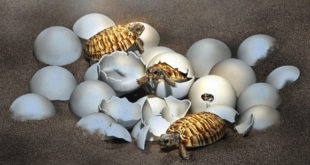
The new specimen from the Upper Cretaceous Xiaguan Formation in the Chinese province of Henan is one of the few known fossilized turtle eggs containing an embryo with anatomical details. An artist’s impression of baby nanhsiungchelyid turtles. Image credit: Masato Hattori. “Fossilized turtles from the Mesozoic are known from a …

Read More »

Seadragon and Pipefish

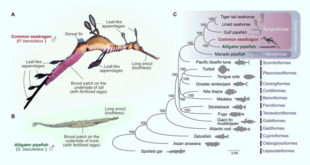
A team of researchers from Germany, China, Singapore, Belgium, and Japan has successfully sequenced and analyzed male and female genomes of the common seadragon (Phyllopteryx taeniolatus) and the alligator pipefish (Syngnathoides biaculeatus). Key features of the common seadragon (Phyllopteryx taeniolatus) and the alligator pipefish (Syngnathoides biaculeatus) and their phylogenetic positions: …

Read More »

Three New Species

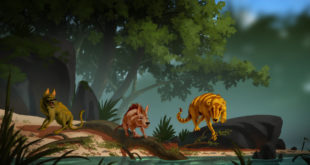
Paleontologists have identified three new species of placental mammals called condylarths (archaic ungulates) from fossils found in Wyoming, the United States. Left to right: Conacodon hettingeri, Miniconus jeanninae, and Beornus honeyi. Image credit: Banana Art Studio. The newly-discovered archaic ungulates are Miniconus jeanninae, Conacodon hettingeri, and Beornus honeyi. These animals …

Read More »
Bizwhiznetwork Consultation