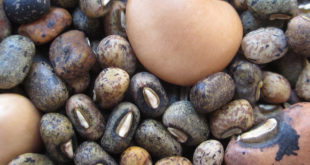
A large international team of researchers has sequenced the genome of the cowpea (Vigna unguiculata), a major crop for worldwide food and nutritional security, especially in sub-Saharan Africa. African farmers domesticated the cowpea (Vigna unguiculata) from its wild form, in a process of unconscious selection over many centuries. Domesticated cowpea …
Read More »DNA of Early Neanderthals Reveals 80,000 Years of Genetic Continuity in Europe
An international team of scientists has sequenced the nuclear genomes of two Neanderthals who lived in Europe around 120,000 years ago. They found that the individuals were more genetically similar to later Neanderthals from Europe than to a roughly contemporaneous individual from Siberia. The findings reveal a stable, 80,000-year ancestry …
Read More »Almond Genome Sequenced
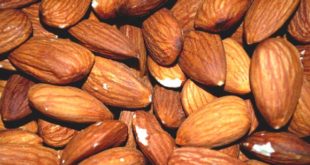
The domesticated almond tree (Prunus amygdalus) has been feeding humans for millennia. Derivation from the wild, bitter, and toxic almond required loss of the cyanogenic diglucoside amygdalin. A team of European scientists has sequenced the almond genome and analyzed the genomic region responsible for this shift. Almond kernels. The almond …
Read More »Scientists Sequence Spider Glue Genes
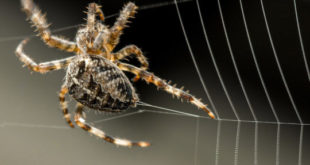
Researchers have published the first-ever complete sequences of two genes that allow spiders to produce glue, a modified version of silk that keeps a spider’s prey stuck in its web. Droplets of water and glue on spider silk. Image credit: Hans Braxmeier. Spiders use a suite of remarkable silk and …
Read More »DNA and Protein Studies Shake Up Sloth Family Tree
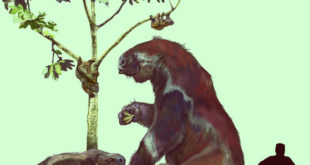
Sloths once roamed the Americas, ranging from cat-sized animals that lived in trees all the way up to giant ground sloths. The only species we know today, however, are the two- and three-fingered sloths. They seem remarkably similar, but new molecular (DNA and protein) studies estimate they last shared a …
Read More »Genetic Analysis Reveals Previously Unknown Group of Ancient Siberians
Northeastern Siberia has been inhabited by humans for more than 40,000 years but its deep population history remains poorly understood. In a new study, published in the journal Nature, researchers investigated the population history of the region through an analysis of 34 ancient human genomes that date to between 31,000 …
Read More »Being Dog Lover Could Be in Your Genetic Makeup
In a study published in the journal Scientific Reports, an international team of researchers from Sweden and the United Kingdom assessed the ‘heritability of dog ownership’ in the Swedish Twin Registry, the largest twin cohort in the world. The results show that genetic variation ‘explains more than half of the …
Read More »Scientists Assemble Pan-Genome of Cultivated Tomato and Its Wild Relatives
An international team of researchers led by Boyce Thompson Institute for Plant Research and the U.S. Department of Agriculture- Agricultural Research Service has created a pan-genome that captures all of the genetic information of 725 cultivated and wild tomatoes, establishing a resource that promises to help breeders develop more flavorful …
Read More »Narwhal Genome Sequenced
A team of researchers from the Natural History Museum of Denmark, the University of Copenhagen, Greenland Institute of Natural Resources and Malaysia’s AIMST University has successfully sequenced and analyzed the genome of the narwhal (Monodon monoceros), the most specialized endemic Arctic cetacean, well known for its elongated horn-like tusk and …
Read More »Researchers Sequence Genome of Cultivated Peanut
An international team of scientists has produced the high-quality genomic sequence for the cultivated peanut (Arachis hypogaea), an important grain legume and oilseed crop with an annual production of about 44 million tons. Leaves and freshly dug pods of Arachis hypogaea, Stuckey, South Carolina. Image credit: Dave, aka Pollinator / CC …
Read More »