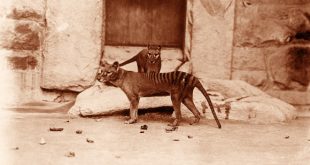
A duo of researchers from the United States and Australia has used an imaging technique to reconstruct the brain architecture and neural networks of the thylacine (Thylacinus cynocephalus), the most iconic animal of Tasmania. A pair of thylacines, a male and female, c. 1905. Image credit: Smithsonian Institutional Archives / …
Read More »Ruby Seadragon Filmed Alive in Ocean for First Time
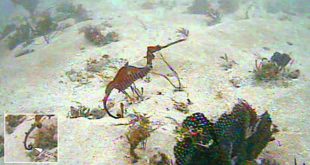
A team of marine biologists from Scripps Institution of Oceanography and the Western Australia Museum has captured on video the first-ever field sighting of the recently-discovered species of seadragon — the ruby seadragon (Phyllopteryx dewysea). The ruby seadragon (Phyllopteryx dewysea) in the Recherche Archipelago, Western Australia. The inset shows a …
Read More »Hoolock tianxing: New Species of Gibbon Discovered in Myanmar and China
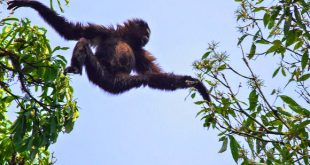
A new species of hoolock gibbon has been discovered in eastern Myanmar and southwestern China by an international team of scientists from the United States, the United Kingdom, China, Australia and Germany. A juvenile male of the Skywalker hoolock gibbon (Hoolock tianxing) from Mt. Gaoligong jumping across trees. Image credit: …
Read More »Study: Endogenous Retroviruses in Genome Important for Human Brain
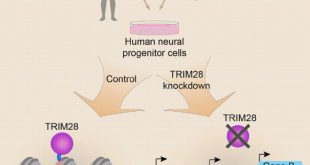
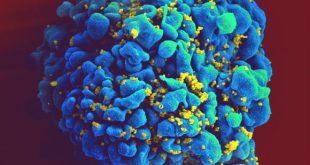
About 8% of the human genome is composed of endogenous retroviruses. According to a new study published in the journal Cell Reports, these retroviruses may have played a significant role in the development of the human brain as well as in various neurological diseases, such as ALS, schizophrenia and bipolar …
Read More »Bryanites graeffii: New Beetle Species Described from 150-Year-Old Museum Specimen
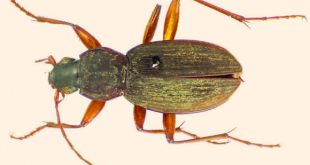
A new species of ground beetle has been identified by Cornell University Professor James Liebherr. Holotype specimen of Bryanites graeffii. Image credit: J.K. Liebherr. “Bryanites graeffii is described from Samoa based on a single male specimen collected between 1862-1870 that was recently discovered in the Muséum national d’Histoire naturelle, Paris,” …
Read More »Hummingbirds Process Motion in Unique Way, Study Shows
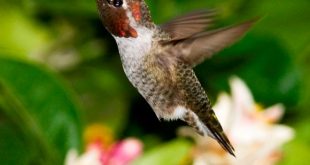
According to new research published in the journal Current Biology, a key area of the hummingbird brain processes motion in a unique, unexpected way. The Anna’s hummingbird (Calypte anna). Image credit: Kevin Cole / CC BY 2.0. The brain area in question is called the lentiformis mesencephali (LM), known in …
Read More »Retroviruses Originated in Ocean 450 Million Years Ago, New Study Says
Retroviruses (Retroviridae) — a family of viruses that includes pathogens such as HIV, feline leukemia, and several cancer-causing viruses — have an ancient marine origin and originated together with, if not before, their jawed vertebrate hosts nearly 450 million years ago in the Ordovician period, according to a new study …
Read More »Biologists Discover New Type of Microbial Photosynthesis
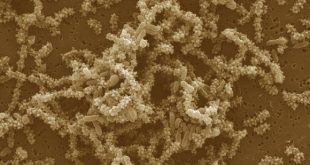
An international team of biologists led by Washington State University Professor Haluk Beyenal has discovered a new type of cooperative photosynthesis that could be used in microbial communities for waste treatment and energy production. A false-color scanning electron micrograph of G. sulfurreducens-P. aestuarii co-culture. Scale bar – 5??m. Image credit: …
Read More »Researchers Discover Off-Switch for CRISPR-Cas9 System
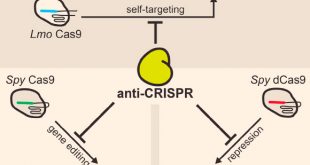
A team of scientists at the University of California, San Francisco, has discovered a way to inactivate the CRISPR-Cas9 gene-editing system using newly identified bacteriophage proteins. The study was published on Dec. 29 in the online edition of the journal Cell. Four newly identified CRISPR-Cas9 inhibitor proteins encoded by Listeria …
Read More »New Estimate: There are Over 18,000 Bird Species on Earth
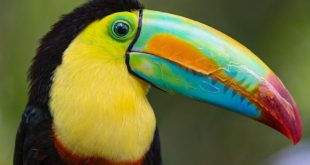
A new study published in the journal PLoS ONE suggests that there are 18,043 bird species in the world — nearly twice as many as previously thought. Toucan. Image credit: Tambako the Jaguar / CC BY-ND 2.0. Birds (class Aves) are traditionally thought of as a well-studied group, with more …
Read More »