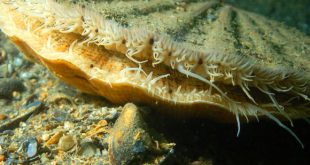
An international group of biologists from Israel and Sweden has obtained a detailed view of a scallop’s visual system — an arrangement of up to 200 eyes they say is strikingly similar to a reflecting telescope. Palmer et al found that spatial vision in the scallop is achieved through precise …
Read More »Study: Dogs Lick Their Mouths as Response to Angry Faces
An international team of scientists from Brazil and the United Kingdom has analyzed mouth-licking behavior of domestic dogs, and found that this behavior is not simply a response to food or uncertainty, but appears to be used as a signal to try to communicate with humans in response to visual …
Read More »Meet Mariana Snailfish, World’s Deepest-Dwelling Fish
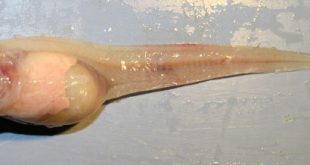
In the frigid darkness of the Mariana Trench swims the world’s deepest-living fish — the Mariana snailfish (Pseudoliparis swirei). The Mariana snailfish (Pseudoliparis swirei). Image credit: Mackenzie Gerringer, University of Washington. Snailfish are found at many different depths in marine waters around the world. In deep water, they cluster together …
Read More »Earth enjoys a surge of ocean sanctuaries
Earth is on the brink of a transformation. Its oceans are still mainly wild, without the obvious human footprint often seen on land, however they’re also increasingly pestered by human-induced risks such as climate change, overfishing and plastic. Yet in spite of our inertia on lots of terrestrial issues like …
Read More »Marine Biologists Discover New Species of Seahorse: Hippocampus haema
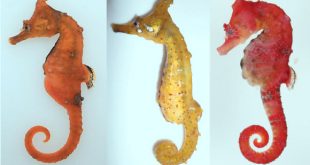
A new species of seahorse has been discovered in the northern Pacific Ocean, near Japan and the Korean Peninsula. Coloration of fresh specimens: Hippocampus haema (left), H. coronatus (center), and H. sindonis (right). Image credit: Han et al, doi: 10.3897/zookeys.712.14955. Seahorses are small marine fishes in the genus Hippocampus. They …
Read More »Crested Pigeons Use Specially Modified Wing Feathers to Signal Danger, Ornithologists Find
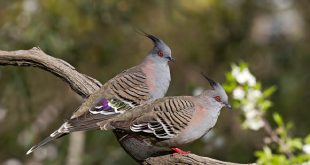
A team of researchers from the Australian National University has solved the mystery of how crested pigeons (Ochyphaps lophotes) create an alarm without using their voice to prompt other birds to flee danger. The findings appear in the journal Current Biology. Murray et al show that crested pigeons (Ochyphaps lophotes) …
Read More »Research Highlights Key Differences between Human and Non-Human Primate Brains
A detailed comparative analysis of adult human, chimpanzee, and macaque brains shows that all regions of the human brain have molecular signatures very similar to those of our primate relatives, yet some regions contain distinctly human patterns of gene activity that mark the brain’s evolution and may contribute to our …
Read More »Synthetic Biologists Create Bacterial ‘Tape Recorder’
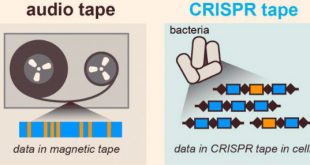
A team of synthetic biologists from Columbia University has successfully converted an immune system of the gut bacterium Escherichia coli into a microscopic ‘tape recorder,’ laying the groundwork for a new class of technologies that use bacteria for everything from disease diagnosis to environmental monitoring. The results are published in …
Read More »New Species of Rafflesia Discovered in Indonesia
An international team of scientists from the United States and Indonesia has described a new species of flowering plant of the genus Rafflesia from the Indonesian island of Sumatra. Rafflesia kemumu. Image credit: Susatya et al / Ministry of Environment and Forestry Republic of Indonesia. Rafflesia is a genus of …
Read More »Vertebrate Teeth Evolved from Ancient Fish Scales, Researchers Say
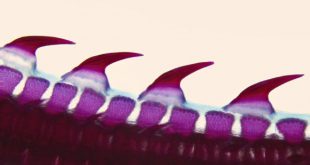
New findings from researchers at the University of Cambridge, UK, support the theory that teeth in the animal kingdom evolved from the jagged scales of ancient fish, the remnants of which can be seen today embedded in the skin of extant cartilaginous fish (sharks, skates and rays). Dermal denticles on …
Read More »