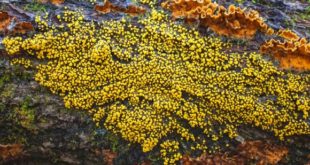
Researchers from Lanzhou University in China have shown that the slime mold Physarum polycephalum is able to solve the Traveling Salesman Problem, a combinatorial test with exponentially increasing complexity, in linear time. Using focused light stimulus as negative feedback to maintain the criteria of the task, the authors demonstrated that …
Read More »Bees Can Solve Counting Tasks with Just Four Neurons, New Study Shows
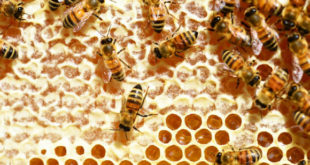
Bees can count up to four or five items, can choose the smaller or the larger number from a group and even choose ‘zero’ against other numbers when trained to choose ‘less.’ According to a new study, published in the journal iScience, bees might have achieved this not by understanding …
Read More »Researchers Find Oldest Known Plant Virus
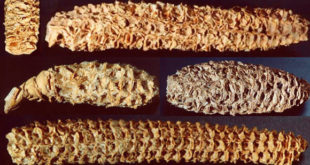
Scientists studying ancient corncobs found at Antelope House, an Ancestral Puebloan ruin located at Canyon de Chelly National Monument, Arizona, have discovered a 1,000-year-old virus, the oldest plant virus ever reported. The discovery is described in a paper this week in the Journal of Virology. Examining 1,000-year-old corncobs from an …
Read More »Dracula Ants’ Mandibles are Fastest Known Animal Appendages
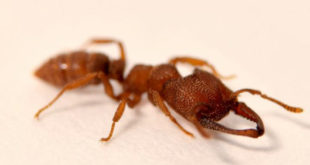
In a study published today in the journal Royal Society Open Science, researchers examined the kinematics and functional morphology of the Dracula ant (Mystrium camillae), who use a snap-jaw mechanism to quickly slide their mandibles across each other similar to a finger snap. The analysis revealed that Dracula ant mandibles …
Read More »Researchers Estimate Total Mass of Earth’s Deep Life: 15-23 Billion Tons of Carbon
An international collaboration of researchers from the Deep Carbon Observatory (DCO) has made several important discoveries, including how much and what kinds of life exist in the Earth’s deep subsurface. Drilling 1.55 miles (2.5 km) into the seafloor, and sampling microbes from continental mines and boreholes more than 3.1 miles …
Read More »Reticulated Siren: New Salamander Species Discovered
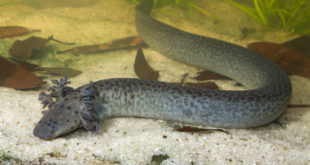
A team of researchers has discovered a new species of salamander living in Alabama and the Panhandle region of Florida, the United States. A reticulated siren (Siren reticulata) from the waters of northwestern Florida (Okaloosa County) rests on an aquarium floor. Image credit: Pierson Hill. The newly-discovered salamander species belongs …
Read More »Study Reveals Origins of Manta Ray’s Horn-Like ‘Cephalic Lobes’
Manta rays and their relatives of the family Myliobatidae have massive, flapping fins as well as a pair of fleshy projections called cephalic lobes. A new study, published in the journal Frontiers in Ecology and Evolution, shows that these two very different features have the same origin — a discovery …
Read More »Jumping Spider Mothers Secrete Milk-Like Substance to Feed Their Offspring
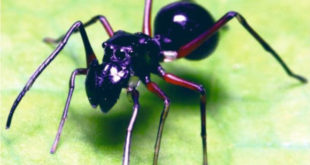
A team of scientists in China has discovered that females of a species of ant-mimicking jumping spider called Toxeus magnus secrete a nutritious milk-like substance to feed their young. The discovery is described in a paper published this week in the journal Science. Toxeus magnus, adult female. Image credit: Chen …
Read More »Among Birds-of-Paradise, Stunning Plumage Is Not Enough to Attract Mates
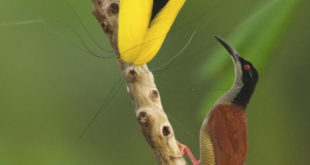
Birds-of-paradise are a family of small to medium-sized forest birds found in the New Guinea region. These birds are among the most beautiful creatures on Earth. Male birds-of-paradise are notorious for their extravagant feather ornaments, complex calls, and shape-shifting dance moves — all evolved to win a mate. According to …
Read More »New Species of Parasitoid Wasp from Ecuador Turns Social Spiders into Zombies
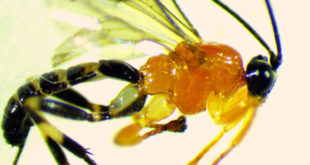
Deep in the Ecuadorian Amazon, a newly-identified species of the parasitoid wasp genus Zatypota transforms Anelosimus eximius, one of only about 25 species of ‘social’ spiders worldwide, into a zombie-like drone that abandons its colony to do the wasp’s bidding. This is the adult stage of the parasitoid wasp Zatypota …
Read More »