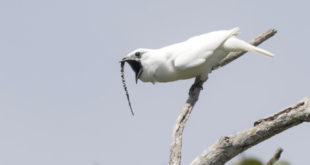
A duo of ornithologists from the United States and Brazil has recorded the loudest bird song (up to 125.4 db) ever documented, made by males of the white bellbird (Procnias albus); the bellbird songs have a sound pressure about 3 times that of the screaming piha (Lipaugus vociferans), an Amazon …
Read More »Scientists Find Pseudothumbs in Aye-Aye’s Hands
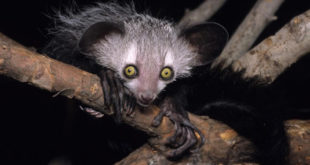
An international team of researchers from North Carolina State University and CNRS have found that aye-ayes (Daubentonia madagascariensis) possess pseudothumbs — which consist of both a bony component and a dense cartilaginous extension — that may help them grip objects and branches as they move through trees. An aye-aye (Daubentonia …
Read More »Spectacled Flowerpecker: New Species of Bird Discovered
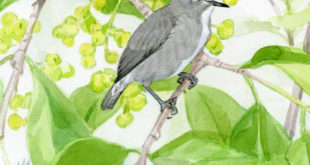
An international team of ornithologists led by by the Smithsonian Institution’s National Museum of Natural History has discovered and scientifically described a new species of flowerpecker from the island of Borneo. The spectacled flowerpecker (Dicaeum dayakorum), an adult female, on March 31, 2019 at the Lanjak Entimau Wildlife Sanctuary, Sarawak, …
Read More »Arapaima Fish Scales are One of Nature’s Toughest Flexible Materials
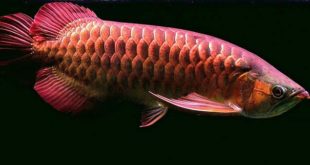
Arapaima gigas is a large Amazonian fish (weighing up to 150 kg) living primarily in seasonal lakes infested with ferocious piranhas. The freshwater giant has armor-like scales that can deform, but do not tear or crack, when a piranha attacks. According to a new study published in the journal Matter, …
Read More »Capuchin and Rhesus Monkeys Outsmart Humans When It Comes to Cognitive Flexibility
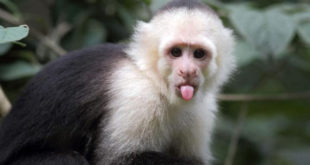
According to a new study published in the journal Scientific Reports, when it comes to being willing to explore more efficient options to solving a problem, capuchin monkeys and rhesus macaques exhibit more cognitive flexibility than our own species. A capuchin monkey. Image credit: Georgia State University. As humans, we live …
Read More »Marine Biologists Discover Two New Species of Porcelain Crabs
A duo of marine biologists from the Smithsonian Tropical Research Institute in Panama and the Justus-Liebig-Universität in Germany has discovered and described two new porcelain crab species. Polyonyx socialis, female, Mun Island, Nhatrang Bay, south coast of Vietnam, South China Sea; right side of carapace deformed by parasitic isopods. Scale …
Read More »Researchers Capture Stunning Video of Whale Bubble-Net Feeding
A research team led by University of Hawai’i at Manoa marine biologists has captured whale’s-point-of-view and aerial drone video of humpback whale bubble-net feeding in the waters off of Southeast Alaska. About 3,000 humpback whales (Megaptera novaeangliae) visit Alaska during the summer feeding period, and up to 10,000 visit …
Read More »Honeybees are Even Better Mathematicians than We Thought
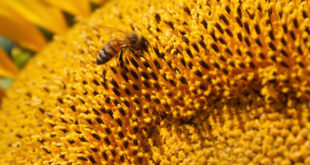
Humans have a threshold limit for instantly processing one to four elements accurately; and it seems that our species is not alone, says a team of scientists from France and Australia. A honeybee (Apis mellifera). Image credit: Joanna Jankowski. “Guppies, angelfish and even honeybees are capable of distinguishing between quantities …
Read More »New Antibiotic Discovered: Phazolicin
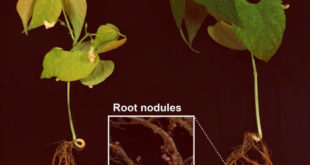
Scientists have discovered an antibiotic produced by a symbiotic nitrogen-fixing bacterium from a tropical forest in Mexico that may help lead to a ‘plant prebiotic.’ Rhizobium sp. forms nodules on bean plant roots, resulting in a more robust plant (right) than on the left. Image credit: Dmitrii Y. Travin. The …
Read More »New Bird Species Discovered in Indonesia: Alor Myzomela
An international team of ornithologists has discovered a new species of the honeyeater genus Myzomela in the highlands of the Lesser Sunda island of Alor, southeast Indonesia. Two individuals of the Alor myzomela (Myzomela prawiradilagae) perched in Eucalyptus urophylla tree at 1,250 m near Manmas-Subo, Alor Island, Indonesia, in April …
Read More »