Archaeologists Find 13,500-Year-Old Bird An international team of archaeologists has uncovered a diminutive carving, depicting a standing bird, at the Paleolithic site of Lingjing in Henan, China. The artifact is estimated to be 13,500 years old, making it the oldest example of East Asian 3D art ever discovered. Lingjing bird …
Read More »Radar Map Ancient City
Archaeologists Use Ground-Penetrating Radar to Map Ancient Roman City of Falerii Novi The first high-resolution ground-penetrating radar survey of a complete ancient Roman town — Falerii Novi, in Lazio, Italy — has revealed previously unrecorded public buildings, such as a temple, a macellum or market building, a bath complex, and …
Read More »Rice Grains in Uzbekistan
Archaeologists Find 1,750-Year-Old Cultivated Rice Grains in Uzbekistan A team of archeologists from China, Uzbekistan, and Germany has found evidence that japonica-like rice was an important food in Central Asia as early as 250 CE. Botanical remains from the Khalchayan site, Uzbekistan: (1-2) Oryza sativa; (3) Hordeum vulgare; (4) Triticum …
Read More »Wooden Throwing Stick
300,000-Year-Old Wooden Throwing Stick Found in Germany A team of archaeologists from the University of Tübingen and the University of Liège has unearthed a well-preserved wooden throwing stick at the Middle Pleistocene open-air site at Schöningen in northern Germany. The 300,000-year-old wooden throwing stick at Schöningen 13 II-4, Germany. Image …
Read More »Hidden Text Uncovered
Multispectral Imaging Uncovers Hidden Text in Fragments of Dead Sea Scrolls Four Dead Sea scroll fragments from the Reed Collection in the University of Manchester’s John Rylands Library, which were previously thought to be blank, do in fact contain text. Reed Collection Ryl4Q22 as it looks using multispectral imaging. Image …
Read More »Gobekli Tepe
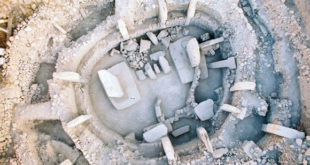
New research from Tel Aviv University sheds light on the building history of monumental structures in the main area of Göbekli Tepe, a Neolithic site in southeast Turkey known for its impressive megalithic architecture with characteristic T-shaped pillars, and the chronological relations between them. Monumental round-oval buildings with their characteristic …
Read More »Earliest Modern Artifact
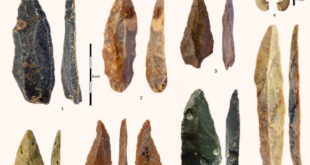
Humans Created Earliest Modern Artifacts in Europe, Research Shows An international team of researchers has discovered and dated the remains of Homo sapiens and associated artifacts — including pendants manufactured from cave bear teeth that are reminiscent of those later produced by the last Neanderthals of western Europe — at …
Read More »Pastoralist Societies
Neolithic East African Pastoralist Societies Consumed Milk New research published in the Proceedings of the National Academy of Sciences provides the first evidence for diet and subsistence practices of Neolithic East African pastoralists. Neolithic rock art in Tassili n’Ajjer National Park, Sahara, Algeria. Image credit: Patrick Gruban, Munich, Germany / …
Read More »Ancient Decorated Ostrich Eggs
Archaeologists Solve Mystery of Ancient Decorated Ostrich Eggs Engraved, painted and embellished with ivory, precious metals and faience fittings, decorated ostrich eggs were traded and exchanged as luxury items around the Mediterranean during the Bronze and Iron Ages. As ostriches are not indigenous to Europe, decorated eggs must have been …
Read More »Neanderthals Making Cords
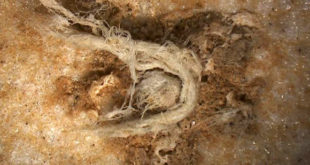
Neanderthals Were Capable of Making Cords Archaeologists working at the Neanderthal site of Abri du Maras in France have discovered a 46,000-year-old cord fragment — the oldest known direct evidence of fiber technology. A cord fragment from the site of Abri du Maras, France. Image credit: C2RMF. Neanderthals are often …
Read More »