A rare gold solidus dating back 1,600 years has been found by a group of Israeli students in the Galilee region. The 1,600-year-old gold solidus, obverse. Image credit: Nir Distelfeld, Israel Antiquities Authority. “The gold coin is a solidus minted by the emperor Theodosius II in Constantinople around 420-423 CE,” …
Read More »Archaeologists Find Ruins of Mitanni-Period Palace in Kurdistan
An international team of archaeologists from Germany and Kurdistan came upon a surprising discovery as the ruins of a 3,400-year-old palace emerge from the waters of the Tigris River at the site of Kemune in the Kurdistan region of Iraq. An aerial view of the Kemune palace from the west. …
Read More »Neanderthals Used Pine Resin as Glue to Haft Stone Tools into Handles
The hafting of stone tools was an important advance in the technological evolution of Paleolithic humans. Joining a handle to a knife or scraper and attaching a sharp point to a wooden shaft made stone tools more efficient and easier to use. According to new research, published in the journal …
Read More »Neolithic Çatalhöyük Experienced Modern Urban Problems
An international team of researchers has found that the inhabitants of the Neolithic settlement Çatalhöyük (7100-5950 BCE) experienced overcrowding, infectious diseases, violence and environmental problems. The research was published in the Proceedings of the National Academy of Sciences. This is an artist’s impression of Çatalhöyük. Image credit: Dan Lewandowski. Çatalhöyük …
Read More »Researchers Find 2.6-Million-Year-Old Oldowan Tools in Ethiopia
An international team of scientists has unearthed a collection of 2.6-million-year-old systematically flaked stone tools at the site of Bokol Dora 1 (BD1) in the Ledi-Geraru area, Ethiopia. Previously, the oldest evidence for systematic stone tool production and use was 2.58 million to 2.55 million years ago. The team’s work, …
Read More »Inhabitants of Neolithic Çatalhöyük Suffered from Intestinal Parasites
An international team of archaeologists has found 8,000-year-old eggs of the whipworm (Trichuris trichiura) in coprolites (fossilized feces) from Çatalhöyük, a prehistoric settlement inhabited from about 7100 to 5600 BCE — the earliest archaeological evidence for intestinal parasite infection in the mainland Near East. This is an artist’s impression of …
Read More »Archaeologists Find 2,300-Year-Old Bark Shield in England
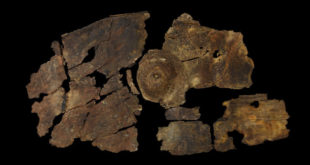
A unique bark shield from the Iron Age has been discovered by a team of archaeologists from the University of Leicester and elsewhere. Archaeologist Adam Clapton records the Enderby shield in the ground. Image credit: University of Leicester Archaeological Services. The bark shield was found in 2015 at the Iron …
Read More »Researchers Brew Beer with 5,000-Year-Old Yeasts
A multidisciplinary team of scientists has successfully isolated several yeast strains from ancient vessels excavated at archaeological sites in Israel. The researchers then brewed ‘aromatic and flavorful’ beer using the ancient yeast strains. Beer cruse from Tell es-Safi/Gath, Israel. Image credit: Yaniv Berman / Israel Antiquities Authority. “We hypothesized that …
Read More »Early Modern Humans Cooked and Ate Starchy Food
An international team of researchers has found numerous fragments of charred starch plant tissues in 120,000-year-old hearths at the archaeological site of Klasies River, the complex of caves and rock shelters located on the Tsitsikamma coast between Port Elizabeth and Plettenberg Bay in South Africa. This new evidence supports the …
Read More »Archaeologists Find High-Quality Jadeite Tool at Ancient Maya Salt-Working Site in Belize
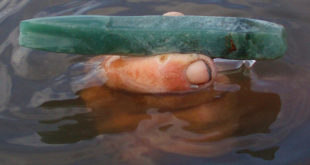
A team of archaeologists has found a jadeite gouge with a rosewood handle at Ek Way Nal, a Classic Maya salt-working site in Belize. The jadeite gouge after discovery. Image credit: Heather McKillop. Jadeite is a hard rock that varies from translucent to opaque. During the Classic Period of 300-900 …
Read More »