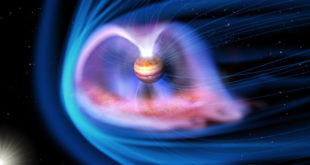
A team of researchers from the Australian National University and the Lawrence Livermore National Laboratory has solved the mystery underlying Jupiter’s colored bands in a study on the interaction between atmospheres and magnetic fields. Magnetic fields around Jupiter can overpower zonal jets that affect atmospheric circulation. Image credit: JAXA. Jupiter …
Read More »Researchers Find Direct Evidence of Water Ice in Moon’s Polar Regions

A team of researchers led by Dr. Shuai Li of the University of Hawaii and Brown University has directly observed definitive evidence of surface-exposed water ice in the lunar polar regions. The distribution and abundance of the lunar ice are distinct from those on other airless bodies in the inner …
Read More »NASA’s OSIRIS-REx Spacecraft Spies Its Target Asteroid
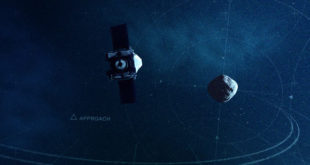
After an almost two-year journey through space, NASA’s Origins, Spectral Interpretation, Resource Identification, Security-Regolith Explorer (OSIRIS-REx) caught its first glimpse of Bennu, a carbonaceous asteroid whose makeup may record the earliest history of our Solar System, last week and began the final approach toward the asteroid. Using its multipurpose PolyCam …
Read More »New Horizons Spots Its Next Flyby Target: Kuiper Belt Object 2014 MU69
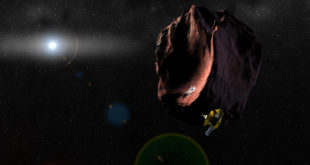
NASA’s New Horizons spacecraft has made its first detection of its next target, the Kuiper Belt object 2014 MU69, more than four months ahead of its 2019 close encounter. Artist’s impression of New Horizons encountering a Pluto-like object in the distant Kuiper Belt. Image credit: NASA / JHUAPL / SwRI …
Read More »Huge Northern Polar Vortex Spotted Forming in Saturn’s Stratosphere
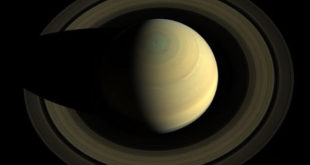
When NASA’s Cassini spacecraft arrived at Saturn in 2004, the gas giant’s southern hemisphere was enjoying summertime, while the northern was in the midst of winter. Cassini spied a broad, warm, high-altitude vortex at Saturn’s southern pole, but none at the northern pole. A study led by the University of …
Read More »Lunar Swirls May Be Produced by Strongly Magnetized Lava
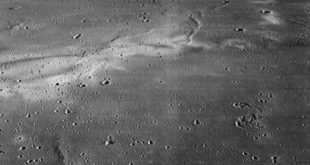
Planetary researchers from Rutgers University and the University of California, Berkeley may have solved the mystery behind lunar swirls, wispy bright regions scattered on the Moon’s surface. The solution hints at the dynamism of the Moon’s ancient past as a place with volcanic activity and an internally generated magnetic field. …
Read More »Researchers Say the Reason Pluto Lost Its Planet Status is Not Valid
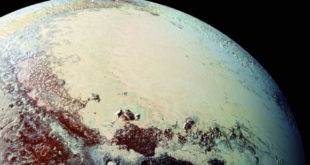
In 2006, the International Astronomical Union (IAU) established a definition of a planet that required it to clear its orbit, or in other words, be the largest gravitational force in its orbit. Since Neptune’s gravity influences Pluto, and Pluto shares its orbit with frozen gases and objects in the Kuiper …
Read More »NASA’s Juno Orbiter Spots ‘Brown Barge’ Cloud on Jupiter
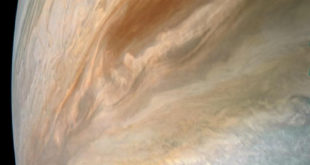
A new image from NASA’s Juno spacecraft shows a long, brown oval known as a ‘brown barge’ in Jupiter’s southern hemisphere. A ‘brown barge’ cyclone in Jupiter’s South Equatorial Belt. Citizen scientist Kevin M. Gill created this image using data from the JunoCam imager aboard NASA’s Juno spacecraft. Image credit: …
Read More »NASA’s Parker Solar Probe Gathers First Data
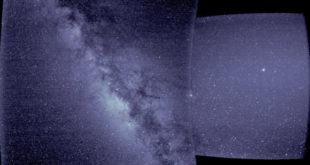
One month after its successful launch, Parker Solar Probe — a NASA’s robotic spacecraft designed to explore the Sun’s atmosphere — has collected and transmitted its first data. First light data from Parker Solar Probe’s WISPR instrument suite: the right side of this image — from WISPR’s inner telescope — …
Read More »Ancient Mars Had Ample Chemical Energy to Support Subsurface Microbial Colonies
Mars had right conditions for subsurface life some 3.7 to 4.1 billion years ago (Noachian period), according to new research from Brown University. An artist’s impression of habitable Mars. Image credit: Daein Ballard / CC BY-SA 3.0. “We showed, based on basic physics and chemistry calculations, that the ancient Martian …
Read More »