Skype

Ancient Maya Captured and Traded Big Cats: Study
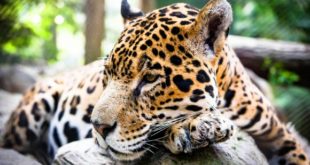
The ancient Maya routinely captured and traded wild jaguars (Panthera onca) and pumas (Puma concolor) for symbolic and ritual purposes, according to an analysis of animal remains from the Maya city of Copan, in present-day Honduras. The jaguar (Panthera onca). Image credit: Marco Verch / CC BY 2.0. Long before …

Read More »

Ancient Maya Produced Salt and Salted Fish: Study

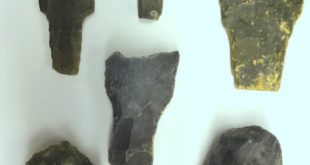
Like the ancient Roman, Asian, and other civilizations, the ancient Maya produced salt and salted fish — storable commodities for marketplace trade, according to a new study published in the Proceedings of the National Academy of Sciences. Stone tools from the Paynes Creek Salt Works, Belize. Image credit: Louisiana State …

Read More »

Giant Dinosaur Foot Proclaimed Largest Ever Discovered

A fossilized dinosaur foot believed to be the largest in the world has been unearthed in Weston County, Wyoming, the United States. This illustration shows a Brachiosaurus eating from an Araucaria tree. These dinosaurs had enormous necks and relatively short tails. The animal to which the foot belongs was nearly …

Read More »

New Sauropod Dinosaur Unveiled: Lingwulong shenqi

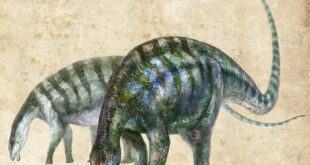
Fossils of a diplodocoid sauropod dinosaur unearthed more than a decade ago in Ningxia Hui Autonomous Region, northwest China, have been recognized as belonging to a new species. An artist’s impression of Lingwulong shenqi. Image credit: Zhang Zongda. Lingwulong shenqi, which lived approximately 174 million years ago (Middle Jurassic epoch), …

Read More »

Research Sheds New Light on How Cave Bears Became Vegetarians

A Middle Pleistocene cave bear, also known as the Deninger’s bear (Ursus deningeri), is generally regarded as the direct ancestor of the mostly vegetarian cave bear (Ursus spelaeus), and the transition between the two species took place around the Middle-Late Pleistocene boundary, about 126,000 years ago. Until now, very little …

Read More »

Cretaceous Alaska Was ‘Superhighway’ for Migrating Dinosaurs, Paleontologists Say

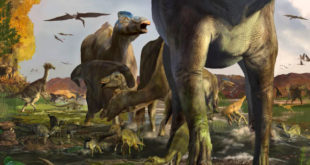
Paleontologists have discovered the first North American co-occurrence of hadrosaur and therizinosaur tracks, providing more evidence that Alaska was the ‘superhighway’ for dinosaurs between Asia and western North America 65-70 million years ago (Late Cretaceous epoch). Life reconstruction of hadrosaur-therizinosaur co-occurrence based on tracks described in this study. Image credit: …

Read More »
Bizwhiznetwork Consultation